
The original BÉIS Weekender was not redesigned because it failed. It was redesigned because millions of customers used it often enough to expose the limits of its design.
Since its launch, the Weekender has become BÉIS’s signature product and one of the most recognizable travel bags on social media. Its structured opening, separate shoe compartment and suitcase-compatible shape helped turn it into a bestseller. But those same features also produced recurring complaints: the bag felt heavy, the wire-framed opening restricted packing, the lower compartment reduced usable space, and carrying it through an airport became uncomfortable once it was full.
Instead of treating those complaints as isolated negative reviews, BÉIS reportedly catalogued criticism from TikTok and other customer channels—including comments about the weight and straps—and used it as a product-development roadmap. The result is a redesigned Weekender that removes the metal frame, connects the upper and lower compartments, reinforces the handles and upgrades the shoulder strap.
The update is more flexible and easier to pack. But it is not automatically better for every traveler. It also sacrifices some capacity and part of the structured “doctor bag” appearance that made the original distinctive.
The redesign therefore reveals something larger than one brand responding to customer feedback: adding more structure and compartments does not always make a travel bag more functional. A successful weekender has to balance organization, usable capacity, empty weight, carrying comfort and the way people actually travel.
Why Did BÉIS Redesign the Weekender Bag?
Introduced as one of BÉIS’s earliest products, the Weekender helped establish the brand’s identity. It offered features that looked immediately useful in product demonstrations: a wide framed opening, a bottom shoe compartment, a laptop sleeve and a trolley pass-through.
Those features also made the bag highly shareable on social media. A packing video could show shoes separated from clothing, a laptop sliding into its own pocket and the entire opening remaining upright while the user packed.
But a feature that performs well in a short demonstration may behave differently during a real trip.
As more customers used the Weekender on flights, road trips and short hotel stays, several problems appeared repeatedly. The bag could become uncomfortable when fully loaded. The wire frame made it difficult to compress. The lower compartment competed with the main compartment for space. Some travelers also expected to use the standard Weekender as an under-seat personal item, even though its dimensions did not always align with airline limits.
According to Business Insider’s report on the redesign, BÉIS gathered negative social-media feedback and translated it into a list of product changes. This was not a complete reinvention. The company still had to protect the recognition and customer equity accumulated around its bestseller.
That is the difficult part of redesigning a mature product: solving known problems without removing the reasons people bought it in the first place.
What Users Disliked About the Original BÉIS Weekender
It Was Heavy Before It Was Fully Packed
The original Weekender weighed approximately 3.86 pounds, or 1.75 kilograms, before anything was placed inside it.
That number may not sound extreme when compared with a rolling suitcase. But a rolling suitcase transfers most of its load to the wheels. A weekender bag transfers its entire weight to the user’s hand, shoulder or upper body.
Once a laptop, shoes, clothing, toiletries and chargers are added, the carrying experience changes quickly. The problem is therefore not only how much the bag weighs when empty. It is the combination of:
- Empty bag weight
- Packed contents
- Shoulder-strap width and padding
- Handle construction
- Position of the load
- Distance the bag must be carried
This explains why some travelers found the original Weekender manageable for a car-to-hotel trip but uncomfortable when walking through an airport or standing in a long security line.
The redesigned Weekender weighs 3.68 pounds, or approximately 1.67 kilograms. That is a reduction of only 0.18 pounds. BÉIS can accurately describe it as lighter, but it has not become an ultralight travel bag.
The more meaningful comfort improvements come from the padded strap, reinforced handles and better distribution of a full load—not from a dramatic reduction in the bag’s empty weight.
The Wire Frame Made Packing More Difficult
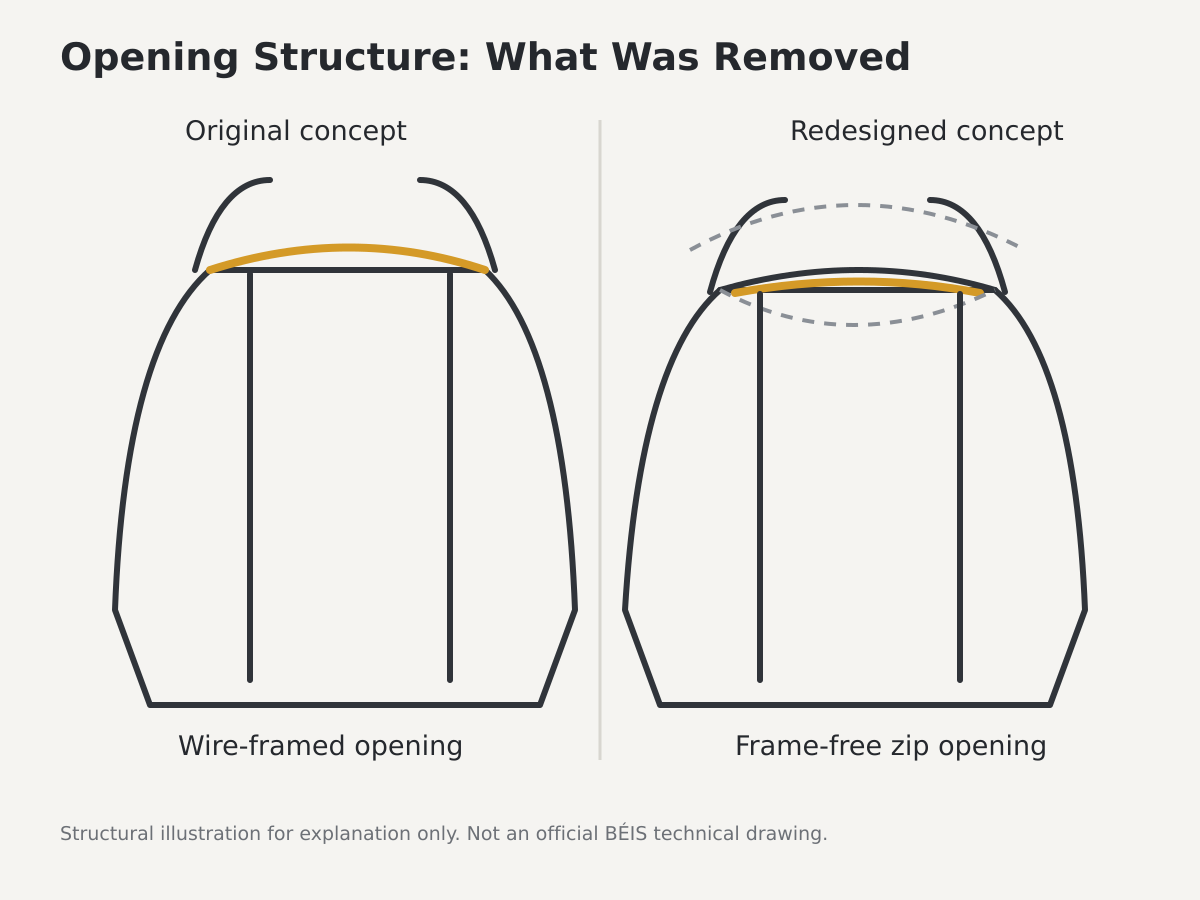
The wire frame around the original opening was both one of the Weekender’s best features and one of its biggest limitations.
It held the opening wide, allowed the empty bag to stand upright and created the recognizable doctor-bag silhouette. When the Weekender was placed on a bed or luggage rack, the user could see and access most of the main compartment.
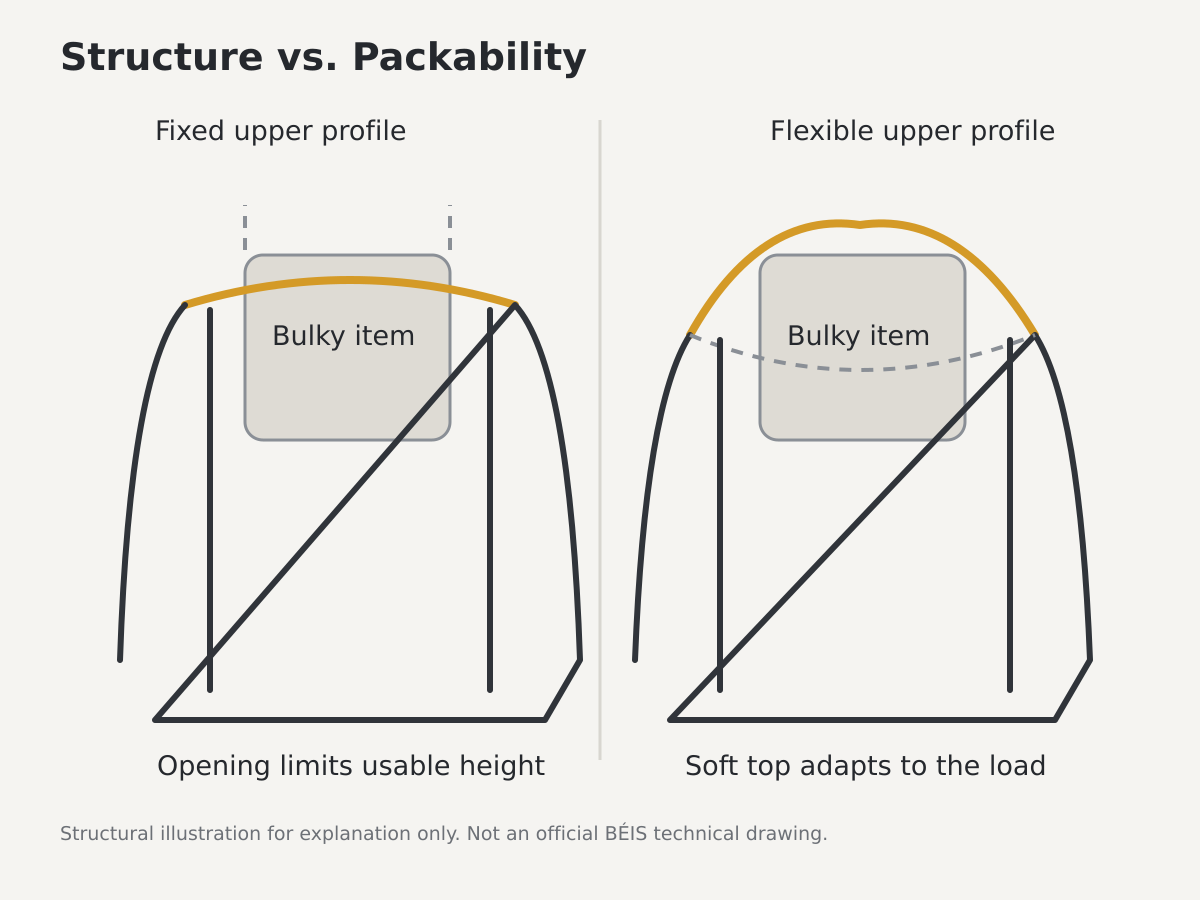
But a rigid frame also determines how the upper part of the bag can move. In practical use, it created several restrictions:
- The opening needed room to expand fully.
- The top could not easily conform around bulky or irregular items.
- The bag was difficult to flatten when not in use.
- Its rigid upper shape made it harder to fit into crowded luggage spaces.
- Packing in a car, airplane seat or other narrow area could be awkward.
The frame did not necessarily reduce the bag’s stated volume, but it could reduce how efficiently that volume was used. Soft clothing may be compressible, yet a fixed opening prevents the top of the bag from adapting freely around it.
The new Weekender replaces the metal frame with a soft, wide opening. In a Good Housekeeping comparison of the two versions, the frame-free construction made the updated bag easier to pack and easier to store when it was not being used.
That solves a real functional problem. It also raises an equally valid design question: without the framed doctor-bag shape, does the Weekender lose some of the visual identity that separated it from an ordinary duffel?
The Shoe Compartment Reduced Usable Main Space
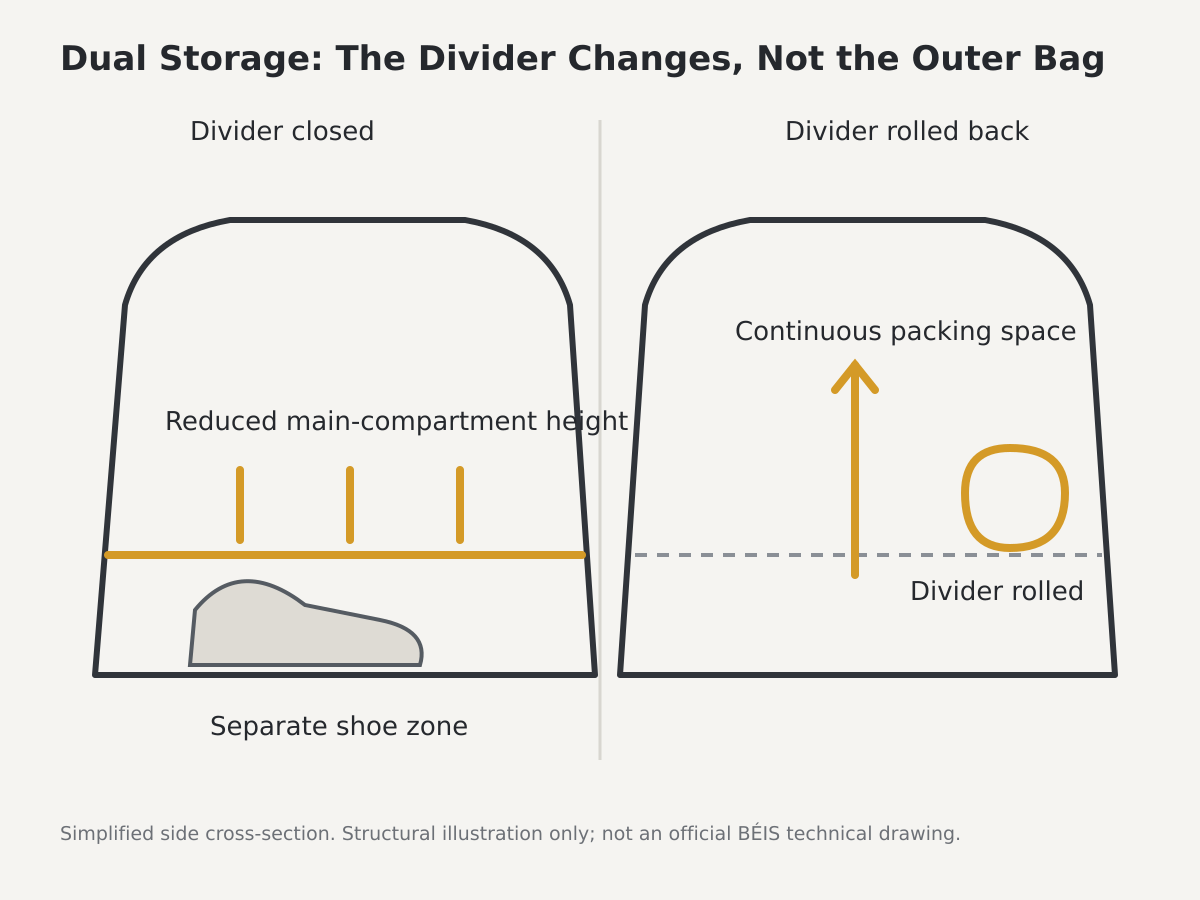
The Weekender’s lower shoe compartment has always been easy to understand. It keeps shoes, toiletries or dirty clothing away from clean clothes and creates a clear organizational system.
However, a separate compartment does not create additional internal volume. It divides the volume that already exists.
When the bottom compartment is full, its contents push upward into the main compartment. This can create several problems:
- The floor of the main compartment becomes uneven.
- Packing cubes may no longer sit flat.
- The usable height of the upper section decreases.
- Bulky items leave empty gaps around the divider.
- The separation remains even when the traveler does not need it.
This is why a bag can appear highly organized while holding less than expected. The number of compartments and the amount of usable capacity are not the same measurement.
The redesigned model keeps the built-in lower compartment, but the internal separator can now be opened and rolled back. BÉIS calls this its “Dual Storage System.” Travelers can use two separated zones when carrying shoes or combine them into one larger space when separation is unnecessary.
This is one of the most meaningful changes in the redesign because it gives the user control over the space. It does not make the bag larger; it allows more of the existing capacity to be used according to the trip.
The Straps Were Not Comfortable Under a Full Load
A strap cannot be evaluated properly when a bag is empty.
As the load increases, pressure becomes concentrated where the strap touches the shoulder. A wider, thicker pad can spread that pressure over a larger area, while reinforced attachment points can reduce distortion where the handles join the body of the bag.
The redesigned Weekender adds more heavily padded carrying straps and reinforces the handle connections. These changes should improve comfort and durability under load, but they cannot completely compensate for overpacking.
A large-capacity shoulder bag presents an unavoidable trade-off: the more it can hold, the more likely the user is to fill it beyond a comfortable carrying weight.
For a short walk from a car to a hotel, that may not matter. For a long airport transfer, it can define the entire experience.
It Was Used as a Personal Item—But Wasn’t Always Personal-Item Friendly
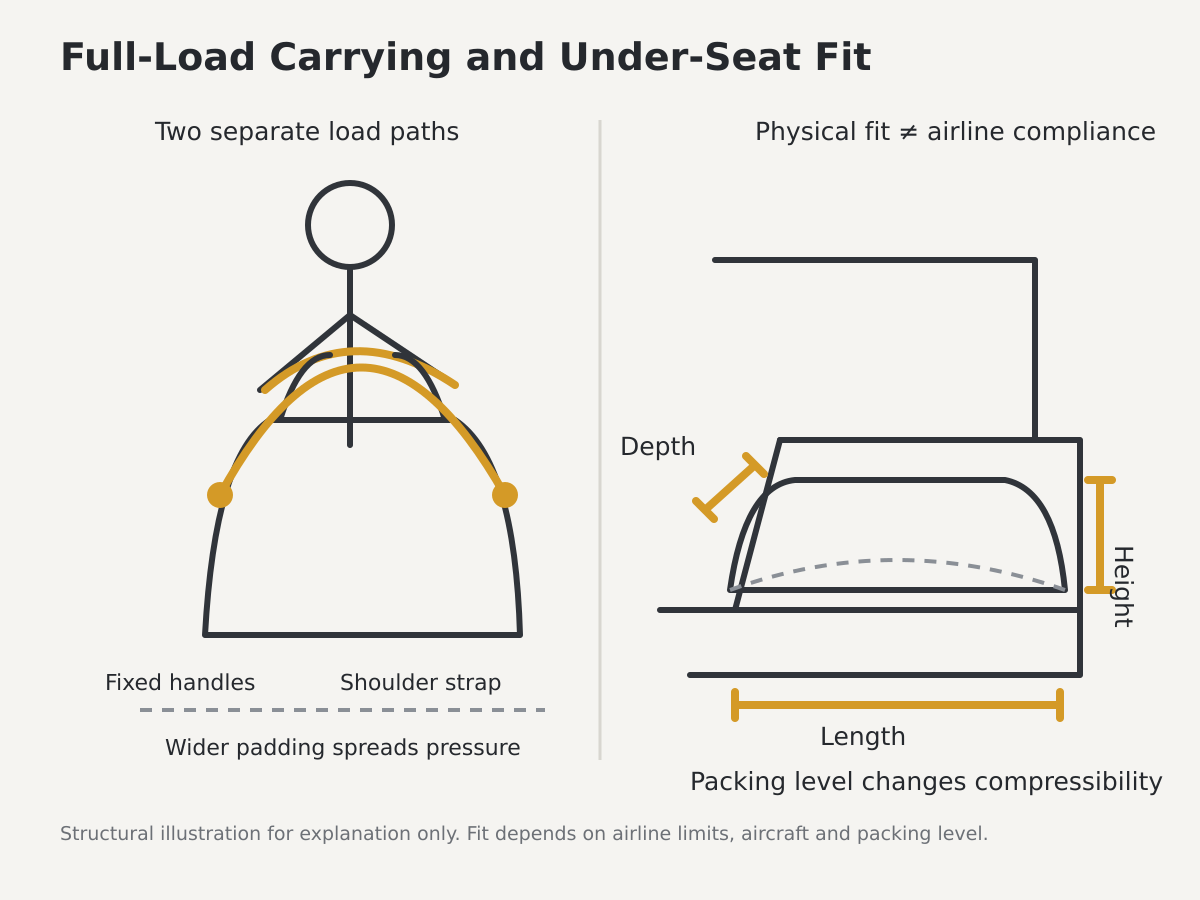
The standard Weekender has often appeared in air-travel content, which encouraged some buyers to view it as an under-seat personal item.
In practice, “it fit under my seat” and “it complies with the airline’s personal-item allowance” are not equivalent statements.
A soft bag that is only partly filled may compress beneath a particular seat. The same bag, packed to capacity, may not fit. Space can also vary by airline, aircraft and seat position. More importantly, airline compliance is based on the carrier’s published allowance, not solely on whether a passenger manages to squeeze the bag into the available space.
The redesigned Weekender measures:
| Specification | New Weekender |
|---|---|
| Length | 17.91 in |
| Height | 15.75 in |
| Depth | 9.84 in |
| Capacity | 42 L |
| Empty weight | 3.68 lbs |
These figures come from the current BÉIS Weekender specifications.
Removing the frame makes the bag easier to compress, but it does not change an airline’s size rules. The standard Weekender is better understood as a short-trip bag or a companion to a rolling suitcase. Travelers intending to place it under a seat should check the exact allowance for their airline and route.
Old vs. New BÉIS Weekender: What Actually Changed?
| Original design or problem | Redesigned feature | Likely practical effect |
| Metal-framed opening | Soft, frame-free wide opening | Easier to pack, compress and store |
| Permanently separated upper and lower spaces | Internal divider can be opened and rolled back | Space can switch between organization and one larger compartment |
| Handle attachments could feel stressed under load | Reinforced padded handles | Better load support and carrying comfort |
| Standard shoulder strap | More heavily padded strap | Spreads pressure across a larger shoulder area |
| Conventional zipper pulls | Connecting zipper clips | Makes accidental or unnoticed opening more difficult |
| Laptop storage for smaller devices | Padded pocket for laptops up to 16 inches | Better suited to current work-travel needs |
| Approximately 49 L | 42 L | More controlled profile, but lower stated capacity |
| Approximately 3.86 lbs | 3.68 lbs | Slight weight reduction, not true lightweight construction |
The most important update is not any individual pocket or strap. It is the decision to make the bag less structurally rigid.
The original design asked the traveler to pack according to the bag’s fixed layout. The new design gives the traveler more freedom to alter that layout.
Did the Redesign Solve the Original Problems?
Several improvements are relatively clear.
The frame-free opening should make the bag easier to access in narrow spaces and easier to flatten for storage. The convertible internal divider reduces the penalty of carrying a built-in shoe compartment when it is not needed. The reinforced handles and padded strap address the way a heavy load feels in use. The larger laptop pocket also reflects the reality that many customers use the Weekender for work as well as leisure.
However, several questions remain.
First, 3.68 pounds is still substantial for an empty shoulder bag. The new Weekender is slightly lighter, but buyers who prioritize low weight may still find it heavy.
Second, the bottom compartment remains permanently attached. Its divider is more flexible, but the base construction, zipper and additional material still contribute weight and bulk.
Third, the listed capacity has fallen from approximately 49 liters to 42 liters. A lower nominal capacity is not necessarily a worse outcome if the space is easier to use, but the change complicates any claim that the new version simply “fits more.”
Fourth, the standard Weekender still cannot be described responsibly as a personal item for every airline. Its softer construction improves its ability to fit into constrained spaces; it does not guarantee compliance.
Finally, removing the metal frame changes the appearance. Some customers will prefer the flexibility, while others may feel that the softer body looks more like the many lower-priced weekender bags influenced by BÉIS’s original design.
The fair conclusion is not that the new version is universally better. It is more flexible and easier to pack, but the better choice depends on whether the traveler prioritizes a structured appearance, maximum capacity, air-travel flexibility or organized road-trip packing.
The Real Problem Was Not One Feature—It Was a Design Trade-Off
Structure vs. Packability
Structured bags stand upright, photograph well and protect their shape. Soft bags compress more easily and adapt to irregular contents.
Adding frames, bottom boards and reinforcement can improve presentation and stability, but every rigid part reduces the bag’s ability to change shape. Neither approach is inherently superior. The correct choice depends on where and how the bag will be used.
The original Weekender’s structure worked especially well when the bag could be placed on a luggage rack or transported by car. It was less helpful when travelers needed to compress it beneath a seat or into a crowded overhead bin.
Organization vs. Usable Capacity
More pockets and dividers can make a product appear more functional. But each divider occupies space, adds seams and restricts how items can be arranged.
A fixed shoe compartment works well when the user carries shoes. When the user does not, it can become an inefficient layer between two spaces.
The new roll-back divider is a better response because it treats organization as optional. The user can choose separation when it creates value and remove the barrier when it does not.
Durability vs. Empty Weight
Thicker fabric, reinforcement tape, metal hardware, padded handles, bottom protection and multiple zippers all contribute to durability. They also contribute to weight.
A manufacturer cannot improve every durability specification while continuing to reduce empty weight indefinitely. The development team has to determine where extra material is necessary and where it adds little value.
This is why bag weight should be reviewed component by component rather than treated as one final number after the sample is complete.
Large Capacity vs. Carrying Comfort
A 40-liter-plus bag can hold enough clothing and equipment to become very heavy. Increasing capacity without considering carrying method can encourage users to pack more than is comfortable for a shoulder bag.
Capacity answers the question “How much can it hold?” Comfort answers “How far can someone realistically carry it?”
Those are different product tests.
A full-load carry test should therefore be part of development, not an afterthought. The bag should be packed with a repeatable load and carried by different users, rather than evaluated only through handle pull tests or static weight tests.
Brand Identity vs. Functional Improvement
The original framed opening was not just a construction choice. It was part of the Weekender’s visual identity.
Removing it improves flexibility but makes the silhouette less distinctive. This is a common risk when updating a bestseller: the feature producing complaints may also be the feature customers recognize most easily.
A redesign must identify which details create true brand equity and which merely remain because they were part of the first version. Functional improvement is important, but a product that becomes indistinguishable from its imitators can lose value even when it performs better.
What Bag Brands Can Learn From the BÉIS Redesign
The most useful lesson is not that every weekender bag should remove its frame or add a convertible divider. It is that customer complaints should be translated into testable development questions.
For example, “this bag is too heavy” is not yet a complete design instruction. A development team needs to ask:
- Is the empty bag too heavy?
- Is the customer packing beyond a comfortable shoulder load?
- Is the strap too narrow?
- Is the padding too soft or too thin?
- Are the attachment points positioned poorly?
- Is weight concentrated on one side of the bag?
- Is the bag being used for a travel scenario it was not designed for?
The same principle applies to comments such as “the bag does not hold enough.” The cause may be total volume, but it may also be a rigid opening, an intrusive divider or a shape that leaves unusable gaps around common packing items.
Before approving a revised travel bag, brands and manufacturers should test at least the following:
- Empty weight
- Standard packing load
- Usable—not only calculated—capacity
- Handle pull strength
- Full-load carrying comfort
- Zipper cycle performance
- Under-seat fit using defined dimensions
- Shoe-compartment interference
- Packed and folded storage volume
- Access in confined spaces
It is also important to test the product in both its intended use case and the use case customers have created for it.
If a bag was designed for road trips but customers repeatedly take it onto budget-airline flights, that behavior should influence the next version—or the brand should communicate more clearly which version is appropriate for under-seat travel.
Mature products usually benefit more from verifiable, targeted improvements than from change for its own sake. Retain the features customers genuinely use, modify the ones that create repeatable problems and validate each change with realistic packing and carrying tests.
Final Verdict: A Smarter Weekender, but Not a Completely Different Bag
The redesigned BÉIS Weekender responds directly to several of the original version’s most consistent complaints.
Its biggest improvement is the ability to switch between separated storage and one continuous packing space. Removing the wire frame also makes the bag easier to pack, compress and store. Reinforced handles and a more padded strap should make a full load more manageable.
But the redesign does not eliminate every compromise.
At 3.68 pounds, the bag is still not especially light. Its stated capacity is lower than before. The built-in bottom compartment continues to add structure, and the standard model should not be assumed to meet every airline’s personal-item allowance. The softer construction may also be less appealing to customers who bought the original for its upright, doctor-bag appearance.
The new Weekender is therefore not simply “better.” It is better adapted to travelers who value flexible packing and easier storage. The original may still appeal more to users who prefer structure, visual definition and road-trip organization.
What makes the redesign worth examining is not one new zipper or strap. It is the process behind it: BÉIS turned scattered complaints into specific product-development questions and then made changes that could be tested.
That is the real lesson for the bag industry. A bestseller can be commercially successful and still contain unresolved design problems. The next version becomes stronger when a brand looks beyond ratings, studies how people actually use the product and understands that every added feature comes with a trade-off.
Frequently Asked Questions
Why did BÉIS remove the Weekender’s wire frame?
The wire frame kept the original opening upright, but it also limited flexibility. Removing it makes the redesigned Weekender easier to pack in confined spaces, compress for storage and fit around irregular contents.
Is the new BÉIS Weekender lighter than the original?
Yes, but only slightly. The original weighed approximately 3.86 pounds, while the redesigned version weighs 3.68 pounds. Most of the carrying improvement is likely to come from the padded straps and reinforced handle construction rather than the 0.18-pound reduction.
What happened to the shoe compartment?
The lower compartment remains built into the bag. However, the divider between the lower and main compartments can now be opened and rolled back, allowing the two sections to function as one larger packing space.
Does the new BÉIS Weekender fit under an airplane seat?
It may fit under some seats when it is not completely full, but this does not mean it complies with every airline’s personal-item allowance. Travelers should compare its 17.91 × 15.75 × 9.84-inch dimensions with the rules of the airline they are flying.
Is the new BÉIS Weekender better than the original?
It is more flexible, easier to store and better at switching between divided and open storage. The original offers a more structured, distinctive shape and a higher listed capacity. The better choice depends on the user’s packing habits and travel style.



