
For a custom backpack project, choosing between RPET and nylon is rarely as simple as deciding between “sustainable” and “durable.” RPET is generally the more straightforward option when recycled content, traceability and sustainability positioning are part of the purchasing requirement. Nylon, meanwhile, is often preferred when buyers prioritize lower weight, abrasion resistance and strength relative to fabric weight.
The final decision should still be based on the actual fabric specification and finished backpack. Denier, GSM, weave, coating, reinforcement, padding and sewing construction can all change the result. A 600D RPET backpack and a lightweight 210D nylon backpack are not equivalent products even though both are commonly used in the same broad backpack category.
Key Takeaways
- Choose RPET when recycled content, GRS/RCS-related sourcing, corporate sustainability programs or retail environmental positioning are important.
- Choose nylon when lower weight, abrasion resistance and higher strength-to-weight performance are more important.
- Do not compare material names alone. Denier, GSM, weave, coating and finished construction can matter as much as fiber type.
- Certified RPET sourcing should be discussed at the quotation stage, including whether a valid Scope Certificate and a Transaction Certificate for the relevant transaction are required.
- Compare the finished backpack cost, not only the price per meter of outer fabric.
| Buying Factor | RPET Polyester | Nylon |
|---|---|---|
| Main Material Source | Recycled PET | Usually virgin polyamide unless recycled nylon is specified |
| Recycled-Material Positioning | Strong | Depends on material source |
| GRS/RCS Sourcing | Common for suitable recycled programs | Possible when certified recycled nylon is specified |
| Strength-to-Weight | Good | Very good |
| Abrasion Resistance | Good to very good | Generally very good |
| Moisture Absorption | Low | Generally higher than polyester |
| Shape Retention | Very good | Good, often more flexible |
| Lightweight Potential | Good | Very good |
| Typical Cost Position | Medium; certification may add cost | Medium to higher depending on grade |
| Typical Applications | Corporate, retail, laptop and recycled-material programs | Travel, technical, lightweight and high-frequency use |
1. Sustainability & Recycled Content
What RPET Actually Means for a Backpack
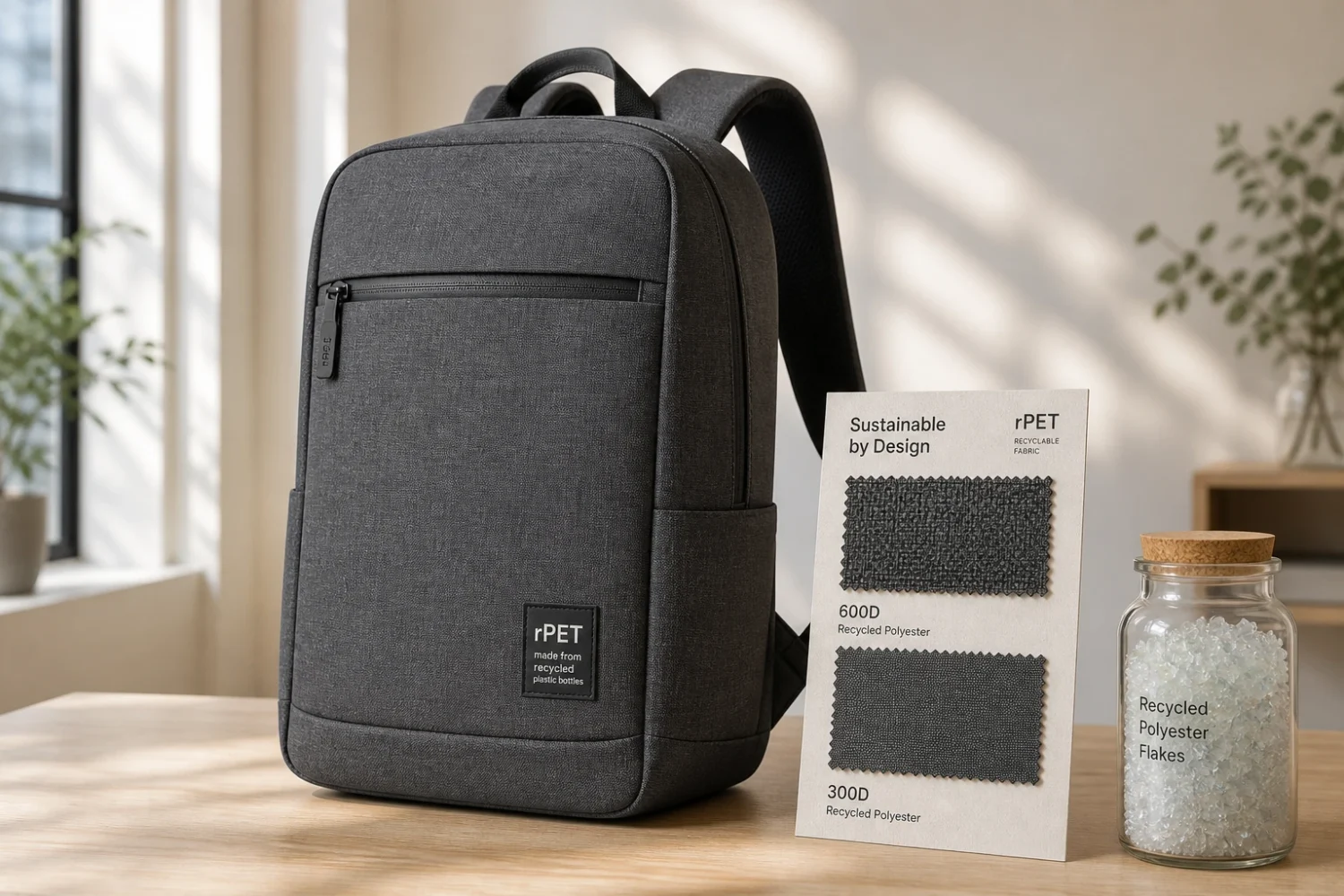
RPET stands for recycled polyethylene terephthalate. In backpack manufacturing, recycled PET is processed into polyester fiber and yarn and then woven into fabrics such as 300D RPET, 600D RPET, RPET Oxford or RPET ripstop.
From a technical perspective, RPET remains polyester. A correctly produced RPET fabric can therefore provide many of the characteristics buyers already expect from conventional polyester, including good dimensional stability, relatively low moisture absorption, a stable printing surface and practical everyday durability.
The main sourcing difference is the origin of the raw material.
This makes RPET particularly relevant for corporate gifts, retail backpack collections, promotional programs and private-label projects where recycled content forms part of the product specification or brand message.
However, using RPET outer fabric does not automatically mean the entire backpack is recycled.
A typical backpack may combine an RPET shell with conventional polyester lining, nylon zippers, polyester webbing, EVA foam, plastic buckles and other components. If only the outer fabric is recycled, the product description should reflect that accurately rather than making an unsupported claim that the entire backpack is “100% recycled.”
GRS, RCS, Scope Certificates and Transaction Certificates
For professional B2B sourcing, “RPET” and “certified RPET” should not automatically be treated as the same specification.
If the buyer requires verified recycled content, the RFQ should clearly state whether materials or the relevant supply chain need to meet GRS — Global Recycled Standard or RCS — Recycled Claim Standard requirements.
Two additional terms are important in actual procurement:
Scope Certificate (SC) confirms the applicable certification scope of a certified organization or facility.
Transaction Certificate (TC) is associated with a specific certified transaction and provides transaction-level traceability for qualifying certified goods.
For buyers, this means that asking only:
“Do you have GRS?”
may not provide enough information.
A more useful sourcing question is:
“Can you confirm the applicable GRS/RCS certification scope, and do we require a TC for this order?”
This should preferably be settled before the final quotation and material booking. Certified-material requirements may influence which fabric supplier can be used, available MOQ, documentation procedures, lead time and unit cost.
The backpack manufacturer does not simply create a TC itself. Where a TC is required, the relevant certified supply chain and certification process must support it.
Recycled Nylon Is Also an Option
Nylon should not automatically be treated as the non-recycled alternative.
Recycled nylon can be specified for projects that need both recycled content and nylon’s performance characteristics. However, depending on fabric construction, volume and local supply, recycled nylon may be less commercially straightforward than mainstream RPET.
For many large corporate or retail programs, RPET is therefore the easier starting point when the buyer’s priority is a recognizable recycled-material story combined with scalable backpack production.
Sustainability Should Include Product Life
Material origin is only one part of a responsible sourcing decision.
A backpack also needs to survive its intended use. Selecting recycled fabric but under-specifying the bottom, shoulder straps or seam reinforcement can result in a shorter product life, which undermines the purpose of choosing a better material specification in the first place.
A stronger sourcing sequence is:
Expected use → durability requirement → recycled-content requirement → certification and traceability
rather than choosing RPET for the claim first and considering performance later.
2. Durability & Mechanical Performance
Nylon Usually Has the Strength-to-Weight Advantage
Nylon is widely used in travel gear, technical backpacks and performance-oriented products because it can provide high mechanical performance at relatively low fabric weight.
Its strengths typically include good abrasion resistance, flexibility and strong performance relative to weight. This makes nylon especially attractive when the backpack will be carried frequently but should remain lightweight.
That does not mean every nylon fabric is more durable than every RPET fabric.
A lightweight 210D nylon and a structured 600D RPET Oxford are designed for different requirements. The heavier RPET construction may provide greater structure and sufficient durability for a laptop or corporate backpack, while the lighter nylon may be more appropriate for a travel pack where weight reduction matters.
Denier, GSM and Weave Must Be Considered Together
Denier describes yarn linear density. It is useful, but it should not be treated as a complete durability rating.
Two fabrics with the same denier can behave differently because of variations in yarn quality, weave density, GSM, coating and finishing. Likewise, a higher-denier material is not automatically the best choice if it creates unnecessary stiffness, weight or cost.
For an accurate comparison, buyers should ask for enough information to understand the complete fabric construction rather than comparing “600D” and “420D” as isolated numbers.
Ripstop construction is another example. Both nylon and recycled polyester can be woven in ripstop patterns designed to limit the propagation of small tears, so tear resistance cannot be judged simply by saying “nylon is stronger.”
Abrasion Is Often More Important Than Tensile Strength
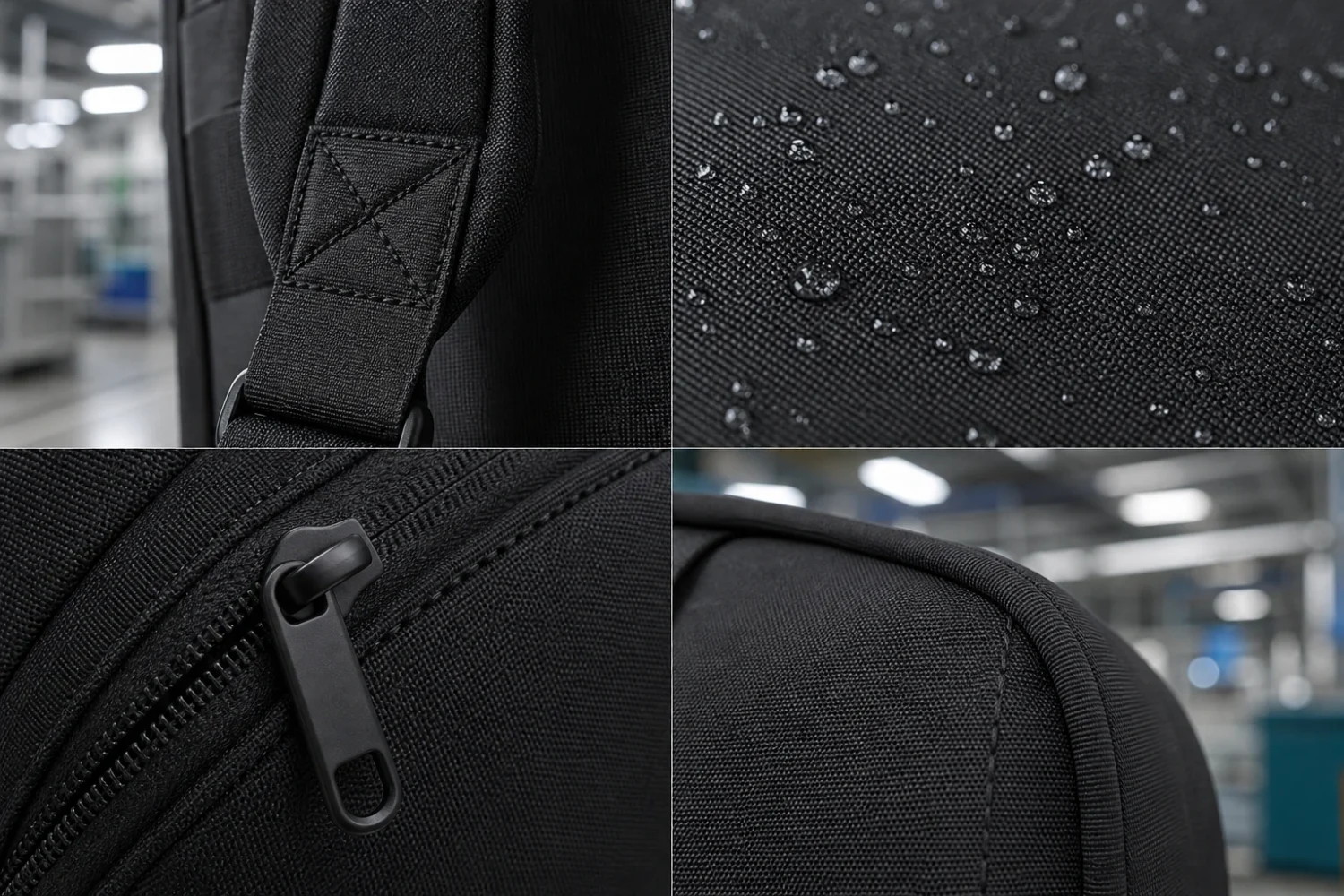
Backpacks rarely fail because the center of a large fabric panel suddenly breaks under a perfect laboratory pull. In everyday use, wear tends to concentrate around the bottom, lower corners, shoulder-strap attachments and areas repeatedly rubbing against clothing, floors, luggage racks, vehicle interiors or other surfaces.
Nylon generally performs strongly in abrasion-heavy environments and is therefore common in travel and technical backpacks.
RPET polyester can still provide very good durability for mainstream backpack programs, particularly in well-specified 600D, 900D or reinforced Oxford constructions. For a corporate laptop backpack that moves between an office, car and commute, a robust RPET fabric may provide more than enough practical performance.
This is why “Which fiber is stronger?” is often less useful than:
“Which fabric and construction are appropriate for this backpack’s actual wear pattern?”
Moisture and Water Resistance
Polyester generally absorbs less moisture than nylon and usually offers good dimensional stability in normal humid conditions. This can be useful for commuter, school and everyday travel backpacks.
Both RPET polyester and nylon can also receive PU coatings, TPU laminations or water-repellent finishes.
However, buyers should distinguish between water-resistant fabric and a waterproof finished backpack.
Even when the outer material resists water effectively, moisture can still enter through seams, stitching holes, conventional zippers and openings. If a backpack is expected to withstand sustained rain, the construction requirements must go beyond selecting RPET or nylon.
Shape, Hand Feel and Finished Weight
RPET polyester is often chosen for backpacks that need a relatively structured appearance. It works well for corporate, school and laptop designs where defined panels and consistent shape are desirable.
Nylon is frequently softer and more flexible, which can benefit travel, packable and technical products.
For projects focused on lightweight performance, nylon can provide an advantage because strong mechanical performance can be achieved with relatively light fabric constructions. But buyers should compare finished backpack weight, not fabric alone.
A backpack may contain significant weight in EVA padding, lining, zipper chains, metal hardware, webbing and internal dividers. Saving weight on the shell has limited value if the rest of the BOM remains heavy.
Construction Can Matter More Than the Fiber
A premium fabric does not guarantee a durable backpack.
Common structural failure points include shoulder-strap attachments, carry handles, bottom corners, zipper ends and heavily loaded seams. A poorly reinforced nylon backpack can fail earlier than a well-developed RPET backpack.
For this reason, material selection should always be paired with finished-product evaluation such as realistic load testing, strap inspection and wear assessment.
3. Price & Total Backpack Cost
RPET vs Nylon Material Cost
There is no reliable universal rule that says RPET is always cheaper than nylon or nylon is always more expensive than RPET.
Fabric quotations depend on denier, GSM, weave, yarn source, coating, finishing, color quantity, order volume and certification requirements.
Mainstream nylon is often priced above conventional polyester because of the underlying material and performance positioning, while RPET may carry a premium over comparable virgin polyester when traceable recycled material is required.
Premium technical nylon, recycled nylon and specialty coated fabrics can move the price considerably higher.
The correct comparison is therefore not:
RPET price vs nylon price
but:
RPET specification A vs nylon specification B for the same backpack performance target.
Certification Changes the Commercial Comparison
For an RPET project, a low quotation does not necessarily represent the same product as a higher quotation if only one supplier has included the required certified-material route.
If the project requires GRS/RCS-related sourcing and transaction documentation, buyers should confirm those requirements before comparing quotations.
Otherwise, two quotations may look similar while representing different:
- Material sources
- Certification scopes
- Documentation requirements
- MOQs
- Supply-chain costs
This is particularly important for brands that need documentation to support downstream recycled-content claims.
Outer Fabric Is Only One Part of the BOM
For a finished backpack, fabric cost is only one line in the bill of materials.
A backpack may also include lining, EVA or EPE foam, air mesh, shoulder webbing, zipper chains, sliders, buckles, internal pockets, hook-and-loop components, labels and packaging.
Labor can also change substantially with structure.
For example, adding a separate laptop opening, multiple organizer pockets, a padded back panel and complicated shoulder straps may affect finished cost more than changing from one mainstream outer fabric to another.
This is why buyers should evaluate:
total finished backpack cost + required performance
rather than optimizing the outer-fabric price in isolation.
Same Backpack, Different Material
Consider a 20-liter commuter backpack with a padded laptop compartment, two main zipper compartments, bottle pockets and padded shoulder straps.
| Specification | 600D RPET Version | Lightweight Nylon Version |
|---|---|---|
| Main Priority | Recycled content + structure | Lower weight + performance |
| Appearance | More structured | Softer / more technical |
| Abrasion Performance | Suitable for normal daily use | Strong for frequent handling |
| Recycled Story | Clear | Requires recycled nylon if needed |
| Finished Weight | Typically higher if using structured fabric | Can be lower |
| Certification Cost | May apply for certified RPET route | Depends on nylon source |
| Best Fit | Corporate / retail / laptop | Travel / premium commuter |
This is a more useful way to compare materials because the backpack structure remains broadly consistent while the material decision changes.
4. Real-World Application & Sourcing Scenarios
Corporate and Laptop Backpacks
For corporate gifts, employee programs and mainstream laptop backpacks, RPET is often a strong starting point.
A typical direction might use 600D RPET outer fabric with polyester or RPET lining and EVA/EPE laptop padding. This combination provides a structured appearance, useful everyday durability and a recycled-material story that can support the customer’s procurement or branding objectives.
Nylon becomes more attractive when the laptop backpack is positioned as a lightweight premium commuter product rather than primarily as a sustainability-led corporate item.
For either option, laptop protection should be judged separately. Outer fabric does not replace proper bottom padding, compartment dimensions or suspension around the device.
Retail and Sustainability-Focused Programs
RPET is particularly well suited to brands launching a recycled-material backpack collection.
In this scenario, the sourcing discussion should cover more than color and denier. Buyers should confirm which components are intended to use recycled materials, what certification documentation is required and how the recycled-content claim will be described.
If the program specifically requires GRS or RCS sourcing, the applicable certification and TC requirement should be confirmed before sampling and bulk material booking.
This reduces the risk of developing an attractive sample first and discovering later that the selected material supply chain cannot meet the documentation requirement.
Travel and Lightweight Commuter Backpacks
For travel products, nylon often becomes more attractive because weight and repeated abrasion are more important.
A lightweight 210D or 420D nylon construction may be suitable when the design needs flexibility and compactness, while stronger grades can be selected for higher-wear products.
A travel backpack can still use RPET successfully, particularly if recycled material forms an important part of the brand proposition. The trade-off should then be evaluated against finished weight, hand feel, cost and durability rather than assuming travel automatically means nylon.
Outdoor and High-Frequency Use
Nylon is often the stronger starting point for outdoor-inspired or high-frequency backpack use because of its abrasion performance and strength-to-weight characteristics.
However, these products also demonstrate why material selection alone is insufficient.
If the bottom panel, seams, zippers or strap attachment points are weak, upgrading the outer fabric to premium nylon will not solve the complete durability problem.
For more demanding use, buyers should evaluate the backpack as a system:
outer fabric + reinforcement + seams + straps + hardware
rather than focusing on a single material specification.
5. Material Selection & Sample Validation
Buyer Decision Matrix
| Project Priority | Recommended Starting Point | Main Reason |
|---|---|---|
| Certified recycled-material program | RPET | Established recycled polyester sourcing route |
| Corporate sustainability backpack | RPET | Recycled-content positioning + structure |
| Mainstream laptop backpack | RPET or Nylon | Depends on branding, weight and price target |
| Lightweight commuter backpack | Nylon | Strength-to-weight advantage |
| Travel backpack | Nylon or RPET | Depends on weight vs sustainability priority |
| High-abrasion / technical use | Nylon | Strong abrasion performance |
| Retail recycled collection | RPET | Clear recycled-material proposition |
| Premium recycled technical product | Project-specific | Compare recycled nylon and RPET specifications |
This matrix should be treated as a sourcing starting point rather than a universal rule. Actual material approval should be based on the final backpack specification.
Sampling Checklist
When comparing RPET and nylon for the same design, use equivalent backpack dimensions, capacity, padding, compartment layout, zippers and shoulder-strap construction. Otherwise, differences in construction can distort the material comparison.
During sample approval, evaluate:
- Finished weight: weigh the complete backpack rather than comparing fabric swatches.
- Abrasion areas: inspect the bottom, corners and other high-contact surfaces.
- Load performance: test the backpack with realistic contents.
- Strap attachments: check reinforcement and deformation under load.
- Shape retention: determine whether the material produces the intended structured or flexible appearance.
- Water resistance: evaluate the finished construction according to actual use conditions.
- Branding: approve printing or embroidery on the actual production fabric.
- Recycled documentation: for certified programs, verify the applicable GRS/RCS sourcing route, certification scope and TC requirement before bulk production.
The approved sample and confirmed material specification should then become the production reference. Changing fabric weight, coating, weave or reinforcement after approval can change both appearance and performance.
Compare RPET and Nylon for Your Backpack Project
If your project has not yet finalized the material, INITI can compare suitable RPET and nylon options against the same backpack requirement.
Send your backpack drawing, reference sample or intended use together with the estimated quantity, target dimensions or capacity, target market, recycled-content requirement and preferred price range.
Based on the project, suitable materials can be compared by denier/GSM, coating, hand feel, finished weight, application, certification route and estimated cost difference.
Buyers can also request RPET and nylon fabric swatches before confirming the production material.
For projects requiring certified recycled content, include the GRS/RCS and TC requirements at the quotation stage so the appropriate material supply chain can be evaluated before sampling and bulk production.
FAQ
Is RPET more sustainable than nylon?
RPET offers a clearer recycled-material route when verified recycled polyester is used. Standard nylon is usually based on virgin polyamide, although recycled nylon is also available. Sustainability should also consider product durability and expected service life rather than recycled content alone.
Is nylon stronger than RPET?
Nylon generally offers very good abrasion resistance and strength relative to weight, but the answer depends on the exact fabrics being compared. Denier, GSM, weave, coating and finished backpack construction can significantly affect performance.
Is RPET durable enough for laptop and travel backpacks?
Yes. Properly specified RPET fabrics are suitable for many laptop, commuter, corporate and travel backpacks. More demanding technical applications may justify nylon depending on weight and abrasion requirements.
What are GRS, RCS and TC in an RPET backpack order?
GRS and RCS are recycled-material certification standards. A Scope Certificate relates to the certification scope of an organization or facility, while a Transaction Certificate provides transaction-level documentation for qualifying certified goods. Buyers should confirm the required documentation during quotation.
Which material is more expensive: RPET or nylon?
Neither is always more expensive. Price depends on fabric grade, denier, GSM, coating, quantity, recycled source and certification requirements. The most useful comparison is the total finished-backpack price for equivalent performance.
- Ready to compare fabric options or request physical swatch decks?
- Send your tech pack or reference photos to info@initibag.com (or WhatsApp: +86 193 5730 2370) to receive an itemized DDP quotation with verified GRS supply-chain options.



