
Introduction
A travel shoe bag looks like a simple product, but the material changes how well it performs.
A shoe bag may need to:
- Keep footwear separate from clothing
- Reduce dirt transfer inside luggage
- Allow shoes to breathe
- Resist abrasion from soles
- Handle moisture from sports or travel
- Fold flat when not in use
Four common material options are:
- Non-woven polypropylene
- Polyester
- Nylon
- Mesh
Each has a different balance of:
cost + weight + durability + ventilation + moisture resistance
For B2B buyers, the right choice depends mainly on how the shoe bag will be used.
A promotional shoe dust bag does not need the same construction as a reusable travel organizer for sports shoes.
Quick Comparison
| Material | Weight | Durability | Ventilation | Moisture Resistance | Cleaning | Cost | Best For |
|---|---|---|---|---|---|---|---|
| Non-Woven PP | Light | Low to moderate | Moderate | Limited | Moderate | Low | Promotional and basic storage |
| Polyester | Light to medium | Good | Limited | Good with coating | Good | Competitive | General travel shoe bags |
| Nylon | Very light | Very good | Limited | Good with coating | Good | Medium to higher | Premium lightweight travel |
| Mesh | Very light | Moderate to good | Excellent | Low | Easy | Low to medium | Sports and ventilated shoe bags |
1. Non-Woven Polypropylene
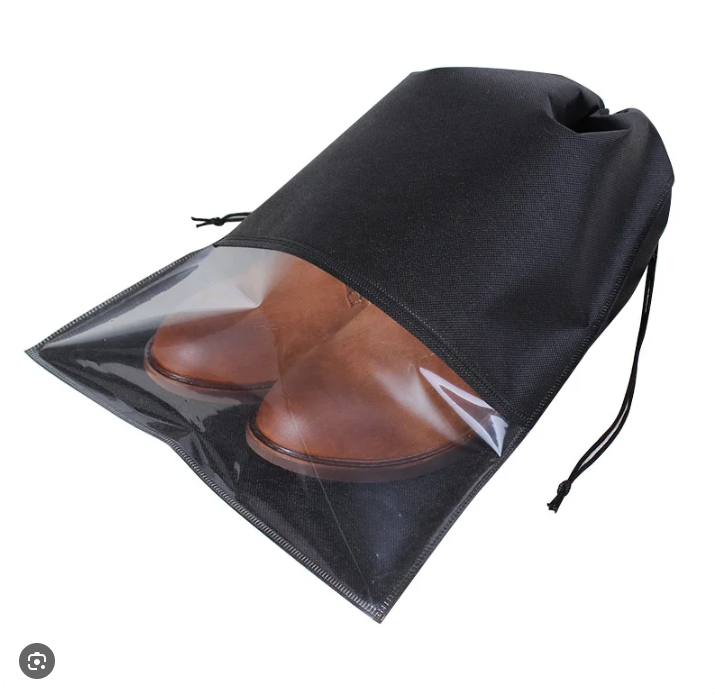
Non-woven PP is one of the most economical options for shoe bags.
It is commonly used for:
- Shoe packaging
- Retail dust bags
- Promotional shoe bags
- Basic closet storage
The material is lightweight and easy to produce in large quantities.
Advantages of Non-Woven Shoe Bags
Low Cost
Non-woven PP is useful for projects where unit cost is the main priority.
This makes it suitable for:
- Shoe brands
- Hotels
- Promotional programs
- Retail packaging
Lightweight
The material adds very little weight to the final product.
Easy Branding
Simple logos can be added through:
- Screen printing
- Heat transfer
depending on the material specification.
Limitations of Non-Woven
Non-woven material generally provides lower resistance to repeated abrasion than woven polyester or nylon.
This matters because shoe soles can create:
- Friction
- Sharp local pressure
- Dirt accumulation
After repeated travel use, low-GSM non-woven fabric may show:
- Tearing
- Stretching
- Surface wear
For long-term reusable products, woven fabrics are usually more appropriate.
Moisture Performance of Non-Woven
Standard non-woven PP provides limited moisture protection.
It can help separate dry dirt from clothing, but it should not automatically be described as waterproof.
A coated or laminated non-woven construction can improve moisture resistance, but it also increases:
- Cost
- Weight
- Structure
Best Uses for Non-Woven
Choose non-woven when the priorities are:
- Low cost
- Large order quantity
- Simple shoe separation
- Retail packaging
- Promotional use
It is less suitable when the bag is expected to survive years of frequent travel.
2. Polyester
Polyester is one of the most practical materials for reusable travel shoe bags.
Common specifications may include:
- 190T polyester
- 210D polyester
- 420D polyester
- 600D polyester
The correct specification depends on the required balance between:
- Weight
- Durability
- Structure
Advantages of Polyester
Good Durability
Polyester generally performs well under repeated travel use.
It can resist:
- Shoe sole abrasion
- Repeated packing
- Friction inside luggage
Good Cost-Performance Balance
Polyester is widely available and often more economical than comparable nylon.
Easy to Customize
It supports:
- Screen printing
- Heat transfer
- Embroidery
and can be produced in many colors.
Moisture Resistance of Polyester
Polyester can be combined with:
- PU coating
- Water-repellent treatment
to improve moisture resistance.
This is useful when shoes may be:
- Slightly damp
- Dirty
- Used outdoors
However, a coated polyester shoe bag with stitched seams is still better described as water-resistant rather than waterproof.
Polyester for Zipper Shoe Bags
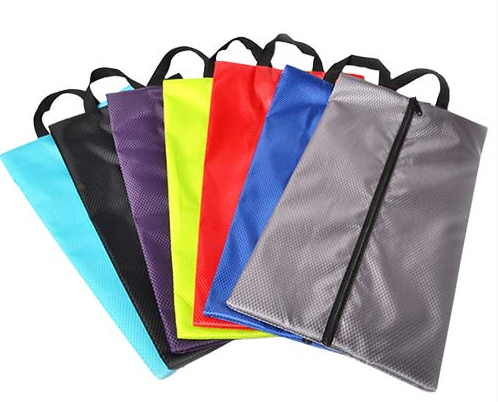
Polyester works particularly well for structured shoe bags with:
- Zipper closure
- Carry handle
- Side gussets
A common construction may use:
210D or 420D polyester + zipper + webbing handle
This creates a more durable travel organizer than a basic drawstring dust bag.
Best Uses for Polyester
Polyester is suitable for:
- Travel shoe organizers
- Hotel shoe bags
- Sports footwear bags
- Retail accessories
- Reusable packing bags
Choose polyester when the priorities are:
durability + cost + customization
3. Nylon
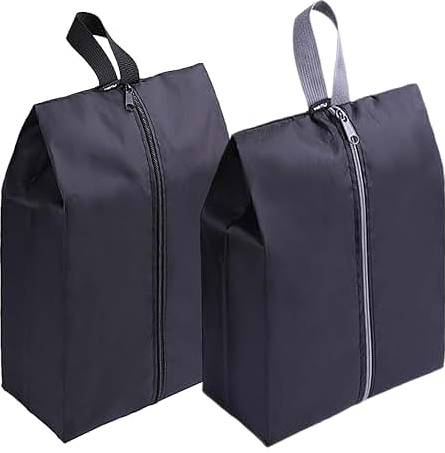
Nylon is especially useful when buyers want a stronger material at a low finished weight.
It is commonly used for:
- Lightweight travel bags
- Outdoor equipment
- Sports accessories
For shoe bags, it works well when compactness and durability are important.
Advantages of Nylon
Excellent Strength-to-Weight
Nylon can provide strong performance without making the shoe bag bulky.
This is valuable for travelers who want to minimize luggage weight.
Strong Abrasion Resistance
Shoes can repeatedly rub against the inside of the bag.
Nylon generally handles this type of friction well.
Compact Packing
Lightweight nylon shoe bags can be folded into very small spaces when empty.
This makes them suitable for:
- Carry-on luggage
- Backpacks
- Business travel
Limitations of Nylon
Nylon usually costs more than standard polyester or non-woven PP.
For simple promotional projects, that additional cost may provide little practical value.
Nylon may also absorb slightly more moisture than polyester, although this is usually not a major issue for normal travel shoe storage.
Coated Nylon
Nylon can be combined with PU coating for improved moisture resistance.
This is useful for:
- Outdoor shoes
- Sports shoes
- Travel footwear
Again, the complete product should not be called waterproof unless:
- Seams
- Zippers
- Closures
also support that performance.
Best Uses for Nylon
Choose nylon when:
- Weight matters
- Frequent reuse is expected
- Abrasion resistance is important
- The product is positioned as a premium travel accessory
Nylon is especially suitable for high-quality compact travel shoe bags.
4. Mesh
Mesh is fundamentally different from the other three options.
Its main advantage is:
ventilation
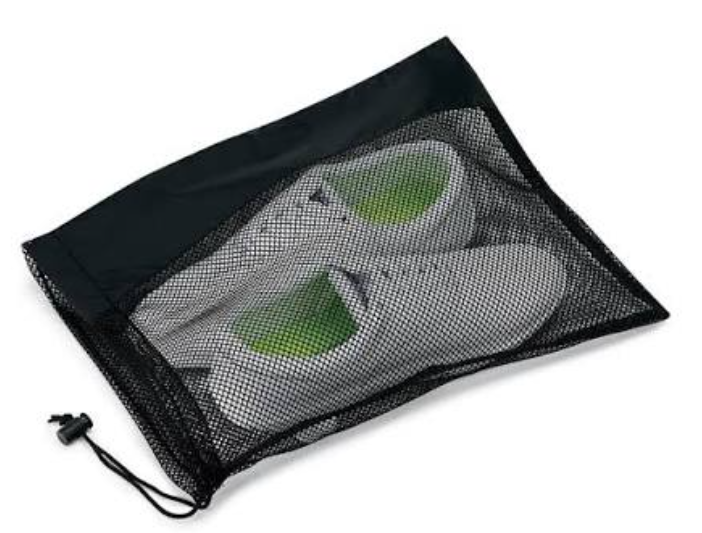
A mesh shoe bag allows air to circulate around footwear.
This can help reduce trapped:
- Heat
- Humidity
- Odor
Advantages of Mesh
Excellent Ventilation
Mesh is highly suitable for:
- Running shoes
- Gym shoes
- Sports footwear
where shoes may still contain moisture after use.
Easy Visibility
Users can quickly see which shoes are inside.
This is useful for:
- Sports teams
- Travel organizers
- Closet storage
Low Weight
Mesh adds very little weight.
Limitations of Mesh
Mesh does not contain:
- Dust
- Dirt
- Moisture
as effectively as solid fabric.
Fine dirt may pass through the openings.
For luggage use, this can be a problem if the primary purpose is to keep dirty soles away from clean clothing.
Mesh is therefore better when ventilation is the priority.
Full Mesh vs Mesh Panel
A useful alternative is to combine materials.
For example:
Polyester body + mesh ventilation panel
This provides:
- Dirt containment
- Better durability
- Some airflow
This hybrid construction is often more practical than making the entire shoe bag from mesh.
Non-Woven vs Polyester
This comparison often comes down to:
price vs reuse
Choose non-woven when:
- Cost matters most
- Usage is limited
- The bag is part of retail packaging
Choose polyester when:
- The bag is expected to travel repeatedly
- Stronger seams and zipper construction are needed
For most reusable travel programs, polyester provides better long-term value.
Polyester vs Nylon
Both are strong choices.
Polyester
Better for:
- Cost control
- Standard travel products
- Large-volume orders
Nylon
Better for:
- Lightweight premium bags
- Frequent use
- Higher abrasion resistance
The difference is usually less important than selecting the correct:
- Fabric weight
- Coating
- Construction
Mesh vs Solid Fabric
The main trade-off is:
ventilation vs containment
Mesh helps shoes breathe.
Solid fabric better contains:
- Dust
- Dirt
- Sand
For gym shoes, mesh may be better.
For formal shoes packed in a suitcase, a solid polyester or nylon bag is usually more appropriate.
Should Shoe Bags Be Breathable?
Not always.
For dry shoes, ventilation is less important.
For:
- Running shoes
- Gym shoes
- Golf shoes
airflow can be useful.
For dirty travel shoes, buyers may instead prioritize:
- Dirt containment
- Easy cleaning
This is why the intended footwear matters.
Moisture and Wet Shoes
A shoe bag should not be used for long-term storage of wet footwear unless specifically designed for that purpose.
A fully closed polyester or nylon bag can trap:
- Moisture
- Odor
If shoes are damp, a mesh panel or ventilation eyelet may help.
However, damp shoes should ideally be dried before long-term storage.
5. Drawstring vs Zipper Construction
Material and closure should be selected together.
Drawstring
Suitable for:
- Non-woven
- Lightweight polyester
- Nylon
- Mesh
Advantages:
- Low cost
- Lightweight
- Simple
Best for:
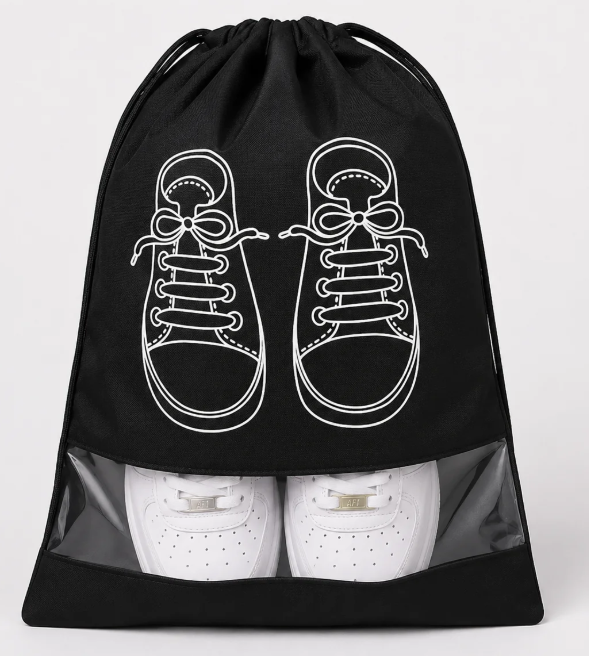
Zipper
Suitable for:
- Polyester
- Nylon
- Hybrid mesh designs
Advantages:
- More secure closure
- Better travel organization
- More structured product
Best for:
6. Single Shoe vs Pair Shoe Bags
Some travel programs use one bag for a pair of shoes.
Others use separate bags for each shoe.
Pair Bag
Advantages:
- Simpler packing
- Lower total material use
Individual Shoe Bags
Advantages:
- Smaller packed shape
- Better separation
- Useful for premium footwear
For formal or high-value shoes, separate shoe bags can reduce shoe-to-shoe rubbing.
7. Shoe Bag Size
A travel shoe bag should fit the intended footwear without excessive unused space.
Buyers should consider:
- Shoe length
- Shoe width
- Sole thickness
- High-top construction
Different footwear requires different dimensions.
For example:
- Flats
- Running shoes
- Men’s formal shoes
- Basketball shoes
cannot always use the same bag efficiently.
8. Gusseted Shoe Bags
Side or bottom gussets provide additional internal volume.
They are especially useful for:
- Sneakers
- Hiking shoes
- Bulky footwear
A flat bag may work well for:
- Slippers
- Flats
- Lightweight formal shoes
The bag structure should follow the shoe shape.
9. Easy-Clean Interior
Travel shoe bags frequently come into contact with:
- Dust
- Mud
- Sand
For this reason, easy cleaning can be important.
Polyester and nylon with smooth coated surfaces are relatively easy to wipe.
Mesh can often be washed easily but may allow dirt to escape through the openings.
Non-woven may be less suitable for repeated aggressive cleaning.
10. Bottom Reinforcement
For structured shoe bags, the sole rests against the bottom panel.
This area receives the highest abrasion.
Possible solutions include:
- Double fabric
- Higher-denier polyester
- Coated bottom
This is more important for:
- Golf shoes
- Hiking shoes
- Heavy sneakers
than for lightweight dress shoes.
11. Ventilation Eyelets
Instead of mesh, solid shoe bags can include small ventilation eyelets.
This provides limited airflow while keeping most dirt inside.
This can work well for:
- Golf shoe bags
- Structured sneaker bags
However, eyelets add:
- Hardware
- Labor
- Cost
For simple travel bags, a mesh panel may be more economical.
12. Handle Construction
Some travel shoe bags include a small carrying handle.
This is useful when the product doubles as:
- Gym shoe bag
- Sports accessory
- Locker-room organizer
Common options include:
- PP webbing
- Polyester webbing
- Self-fabric handle
The handle usually does not need the heavy reinforcement required for grocery or tool bags, but it should still match the expected footwear weight.
13. Branding
Different materials offer different branding options.
Non-Woven
Suitable for:
- Simple screen printing
Polyester
Suitable for:
- Screen printing
- Heat transfer
- Embroidery
Nylon
Suitable for:
- Screen printing
- Heat transfer with compatible process
Mesh
Direct printing can be more difficult because of the open structure.
For mesh designs, branding is often placed on:
- Solid fabric panel
- Woven label
- Printed patch
Practical Material Recommendations
Basic Promotional Shoe Bag
Material: Non-woven PP
Closure: Drawstring
Priority: Low cost + simple branding
Standard Travel Shoe Bag
Material: 210D or 420D polyester
Closure: Zipper
Priority: Durability + cost + easy packing
Premium Lightweight Travel Shoe Bag
Material: Nylon
Closure: Zipper or drawstring
Priority: Low weight + durability + compactness
Sports Shoe Bag
Material: Polyester + mesh panel
Closure: Zipper
Priority: Ventilation + dirt containment
Closet Shoe Dust Bag
Material: Non-woven or lightweight polyester
Closure: Drawstring
Priority: Dust protection + storage
What Should Buyers Check During Sampling?
Fit
Test the actual footwear.
Do not rely only on nominal shoe size.
Abrasion
Check the areas touching the soles.
Seam Strength
Load the bag with heavy footwear and inspect:
- Bottom
- Zipper ends
- Handle attachment
Ventilation
For sports products, check whether airflow is sufficient.
Cleaning
Test how easily dirt can be wiped or washed away.
Foldability
A travel shoe bag should pack compactly when empty.
Common Buyer Mistakes
1. Using Non-Woven for Heavy Long-Term Use
It may reduce cost but shorten product life.
2. Choosing Full Mesh When Dirt Containment Matters
Mesh may allow dust and sand to escape into luggage.
3. Assuming Nylon Is Always Necessary
For normal travel use, polyester may provide sufficient durability at lower cost.
4. Ignoring Shoe Shape
High-top shoes and bulky sneakers may require gussets.
5. Calling Coated Material Waterproof
Stitched seams and zipper openings may still allow water to pass.
6. Ignoring the Sole Contact Area
The bottom may fail before the side panels if footwear is heavy or abrasive.
Which Travel Shoe Bag Material Should Buyers Choose?
Choose non-woven PP when:
- Cost is the main priority
- The bag is for packaging or promotion
- Long-term heavy use is not required
Choose polyester when:
- Balanced durability and cost are required
- The product is for general travel
- Printing and customization matter
Choose nylon when:
- Low weight is important
- Frequent reuse is expected
- Premium travel positioning is required
Choose mesh when:
- Ventilation matters most
- Sports or gym shoes are the main application
For many products, the best solution may be a hybrid:
polyester body + mesh ventilation panel
This provides better balance between:
- Airflow
- Dirt containment
- Durability
Custom Travel Shoe Bags from INITI
INITI develops custom shoe bags for:
- Travel brands
- Shoe companies
- Sports programs
- Hotels
- Retailers
- Promotional projects
Material options can include:
- Non-woven PP
- Polyester
- Nylon
- Mesh
- RPET polyester
Custom structures can include:
- Drawstring closures
- Zipper closures
- Mesh ventilation panels
- Side gussets
- Carry handles
- Internal dividers
- Printed logos
- Woven labels
For development, buyers can provide:
- Shoe type
- Target dimensions
- Intended use
- Preferred material
- Estimated quantity
- Branding requirement
- Target price
If the material is not finalized, samples can be developed in different constructions and compared for durability, ventilation and cost.
FAQ
What is the best material for a travel shoe bag?
Polyester is one of the most versatile options because it balances durability, weight and cost. Nylon is better for premium lightweight products, while mesh is useful when ventilation is the priority.
Is non-woven suitable for shoe bags?
Yes, particularly for basic packaging, dust protection and promotional projects. It is less suitable for heavy repeated travel use.
Is mesh better for sports shoes?
Mesh provides better ventilation, making it useful for gym and sports footwear. However, it does not contain dirt as effectively as solid fabric.
Is nylon better than polyester for shoe bags?
Nylon generally offers better strength-to-weight and abrasion performance, while polyester is usually more economical.
Should a shoe bag be waterproof?
Not necessarily. Most travel shoe bags mainly need dirt separation and some moisture resistance rather than full waterproof performance.
Is a drawstring or zipper better?
Drawstrings are lighter and cheaper. Zippers provide a more secure and structured travel organizer.
Can polyester and mesh be combined?
Yes. A polyester body with a mesh ventilation panel is a common practical construction for sports shoe bags.
What material is best for premium footwear?
Lightweight nylon, quality polyester or separate soft shoe bags can work well depending on the footwear and brand positioning.
Conclusion
Travel shoe bags serve several different functions:
- Dirt separation
- Shoe protection
- Ventilation
- Organization
The best material depends on which of these functions matters most.
Non-woven PP is best suited to:
- Basic storage
- Promotional projects
- Low-cost packaging
Polyester is best suited to:
- General travel
- Reusable shoe organizers
- Cost-controlled retail products
Nylon is best suited to:
- Lightweight premium travel
- Frequent reuse
- Higher abrasion requirements
Mesh is best suited to:
- Sports footwear
- Gym shoes
- Ventilation-focused designs
For many B2B projects, the most practical solution is not choosing one material exclusively.
A construction such as:
polyester body + mesh ventilation panel
can provide useful airflow while still containing most dirt inside the bag.
The material should therefore be selected according to:
durability + ventilation + moisture control + cost + footwear type
rather than simply choosing the cheapest or lightest fabric.


