
Introduction
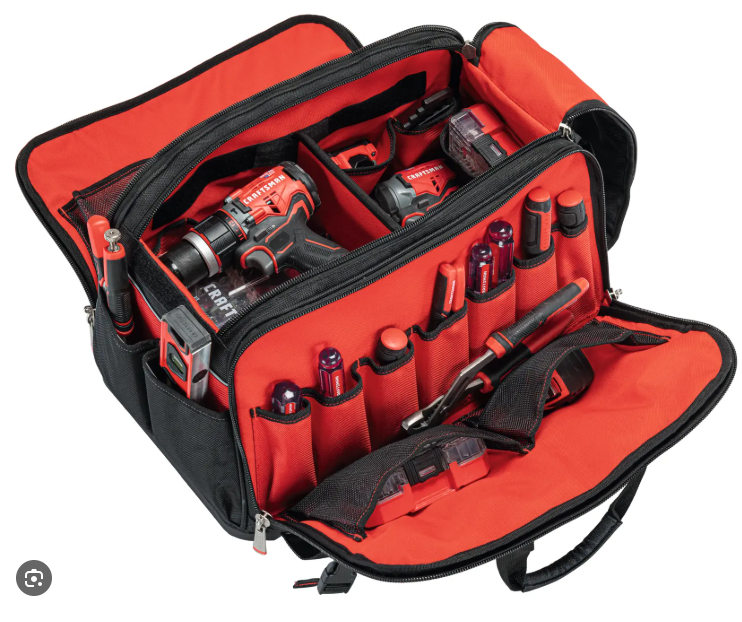
Tool bags place much greater demands on fabric than most everyday bags.
Instead of carrying clothing, books or personal accessories, a tool bag may regularly hold:
- Hand tools
- Measuring equipment
- Metal fittings
- Power-tool accessories
- Fasteners
- Batteries
- Heavy hardware
The bag may also be placed repeatedly on:
- Concrete floors
- Workshop surfaces
- Construction sites
- Vehicle beds
- Rough ground
For this reason, material selection has a direct impact on product life.
Two common polyester specifications considered for tool bags are 600D and 1680D polyester.
At first glance, the choice seems straightforward:
1680D is heavier, so it must be better.
That is only partly correct.
1680D generally provides greater abrasion resistance, stronger structure and more material at high-wear areas. However, it also increases:
- Bag weight
- Fabric cost
- Sewing difficulty
- Shipping weight
600D polyester is lighter, easier to manufacture and more economical. For many general-purpose tool bags, it can provide sufficient durability when combined with good reinforcement.
The correct decision therefore depends on three questions:
- How much abuse will the bag receive?
- How much extra weight is acceptable?
- Does the additional durability justify the higher cost?
What Does 600D and 1680D Mean?
The “D” stands for denier, a measurement of yarn linear density.
A higher denier generally means a thicker yarn.
Therefore, 1680D polyester normally uses much heavier yarn than 600D polyester.
This often results in fabric that feels:
- Thicker
- Heavier
- More rigid
- More abrasion-resistant
However, denier does not describe everything about a fabric.
Actual performance also depends on:
- Weave
- Yarn quality
- Fabric GSM
- Backing
- PU or PVC coating
- Finishing
A well-constructed 600D fabric can perform better than a poor-quality 1680D fabric in some applications.
Buyers should therefore avoid selecting material based only on the denier number.
Quick Comparison: 600D vs 1680D Polyester
| Factor | 600D Polyester | 1680D Polyester |
|---|---|---|
| Fabric Weight | Medium | Heavy |
| Abrasion Resistance | Good | Very good |
| Tear Resistance | Good | Higher |
| Structure | Flexible to medium | More rigid |
| Empty Bag Weight | Lower | Higher |
| Sewing Complexity | Lower | Higher |
| Material Cost | Lower | Higher |
| Packing Efficiency | Better | Lower |
| Best Use | General tool bags | Heavy-duty tool bags |
| High-Wear Areas | May need reinforcement | Very suitable |
What Is 600D Polyester?
600D polyester is one of the most commonly used bag fabrics.
It offers a practical balance between:
- Durability
- Weight
- Cost
- Ease of sewing
It is widely used for:
For tool bags, 600D works particularly well when the product is designed for:
- General household tools
- Light professional use
- Promotional tool kits
- Lower-cost retail programs
600D can also be reinforced strategically in areas that experience more wear.
What Is 1680D Polyester?
1680D polyester is a much heavier fabric commonly used for products that require higher abrasion resistance.
It is often associated with a coarse basket-style weave sometimes marketed as ballistic polyester.
Typical applications include:
Compared with 600D, 1680D usually provides a more substantial feel and holds its shape better.
This makes it attractive for professional tool bags expected to withstand repeated jobsite use.
1. Strength: 1680D Has the Advantage
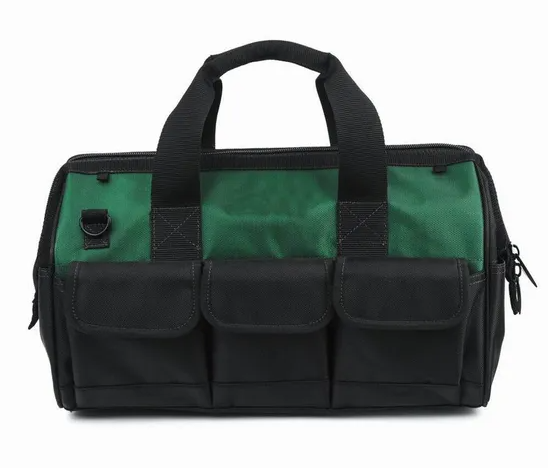
For heavy tool bags, strength is one of the most important considerations.
Tools create concentrated pressure against:
- Bottom panels
- Corners
- Internal dividers
- Side walls
Sharp or heavy items may repeatedly push against the same area.
1680D generally provides better resistance to this type of abuse because the fabric uses heavier yarn and more substantial construction.
This is especially useful for:
- Contractor bags
- Electrician bags
- Mechanic bags
- Heavy equipment carriers
However, fabric strength is only one part of the finished product.
Fabric Strength Does Not Equal Bag Strength
A tool bag usually fails at a stress point rather than in the middle of the fabric.
Common failure areas include:
- Handle attachments
- Bottom seams
- Zipper ends
- Shoulder strap anchors
- Pocket edges
A 1680D bag with weak sewing can still fail quickly.
A well-built 600D bag with:
- Reinforced stitching
- Webbing handles
- Strong thread
- Double-layer bottom
may perform better than a poorly constructed 1680D bag.
For B2B buyers, fabric should therefore be evaluated together with construction.
2. Abrasion Resistance: A Major Difference
Abrasion is particularly important for tool bags.
A bag may be dragged or placed repeatedly on rough surfaces.
The most exposed areas are usually:
- Bottom
- Lower corners
- Side panels
600D polyester provides reasonable abrasion resistance for normal use.
1680D generally performs significantly better in high-wear environments.
This is one of the strongest reasons to select 1680D.
For example, a tool bag used daily on construction sites benefits much more from 1680D than a bag stored mainly inside a vehicle or workshop cabinet.
When Is 600D Strong Enough?
600D is often sufficient when the bag is used for:
- Household tools
- Lightweight equipment
- Occasional field work
- Promotional tool kits
- Lower-priced retail products
If the bag is mostly carried rather than dragged, the additional abrasion resistance of 1680D may never be fully used.
In this situation, 600D can provide better overall value.
When Does 1680D Make Sense?
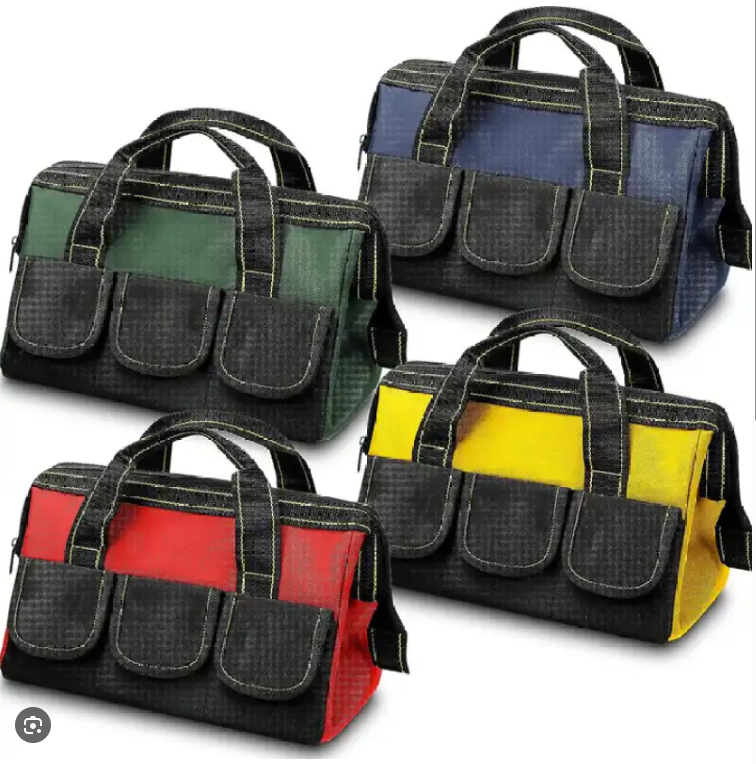
1680D becomes more useful when:
- The bag carries heavy tools
- The bottom regularly contacts concrete
- The bag is used daily
- Long service life is important
- Premium positioning is required
For professional tradespeople, durability can justify the extra weight and material cost.
3. Weight: 600D Has a Clear Advantage
Tool bags are already heavy before considering the fabric.
A loaded bag may contain:
- Wrenches
- Pliers
- Hammers
- Batteries
- Power tools
Adding a heavier outer shell increases the weight the user must carry.
600D helps keep the empty bag lighter.
This can improve:
- Carrying comfort
- Shipping efficiency
- Product handling
For smaller tool bags, using 1680D throughout the entire product can sometimes create unnecessary weight.
How Much Does Fabric Weight Matter?
The difference becomes more significant as the bag gets larger.
A small zipper tool pouch uses relatively little fabric.
A large open-mouth contractor bag uses much more.
As surface area increases, switching from 600D to 1680D affects:
- Finished bag weight
- Carton gross weight
- Freight cost
For large-volume orders, these differences matter commercially.
4. Structure and Shape
1680D polyester generally creates a more structured product.
It can help tool bags:
- Stand upright
- Maintain shape
- Resist collapsing
- Support heavy pockets
This is useful for open-top tool bags where users need quick access to tools.
600D is more flexible.
This can be an advantage for:
Not every tool bag needs a rigid appearance.
5. Cost: 600D Is More Economical
600D is generally more cost-effective.
The reasons include:
- Lower fabric weight
- Lower raw-material consumption
- Easier sewing
- Faster production
1680D costs more because the material is heavier and can also require more demanding production.
For a small order, the difference may be manageable.
For tens of thousands of bags, the total cost increase can become significant.
This is why buyers should avoid automatically specifying 1680D for every panel.
Material Cost Is Not the Only Cost Difference
Heavy fabric can affect production beyond its purchase price.
1680D may require:
- Stronger sewing needles
- Slower sewing speed
- More careful corner construction
Multiple layers can become particularly thick around:
- Handles
- Binding
- Zippers
- Reinforced seams
This can increase production difficulty.
Therefore, the finished-bag cost difference can be larger than the fabric-price difference alone.
6. Shipping Cost
Heavier fabric also affects freight.
For international B2B programs, buyers should consider:
- Carton gross weight
- Pieces per carton
- Container utilization
Tool bags are already relatively heavy products.
Using full 1680D construction can further increase shipping cost.
If only certain areas require extreme abrasion resistance, mixed construction may be more efficient.
Mixed 600D and 1680D Construction
One of the most practical solutions is to use both materials in the same tool bag.
For example:
Main Body
600D polyester
Bottom Panel
1680D polyester
Lower Corners
1680D reinforcement
This construction provides stronger protection where it is actually needed while keeping the rest of the bag lighter and more economical.
For many B2B projects, this is more efficient than making the entire bag from 1680D.
Why the Bottom Panel Matters Most
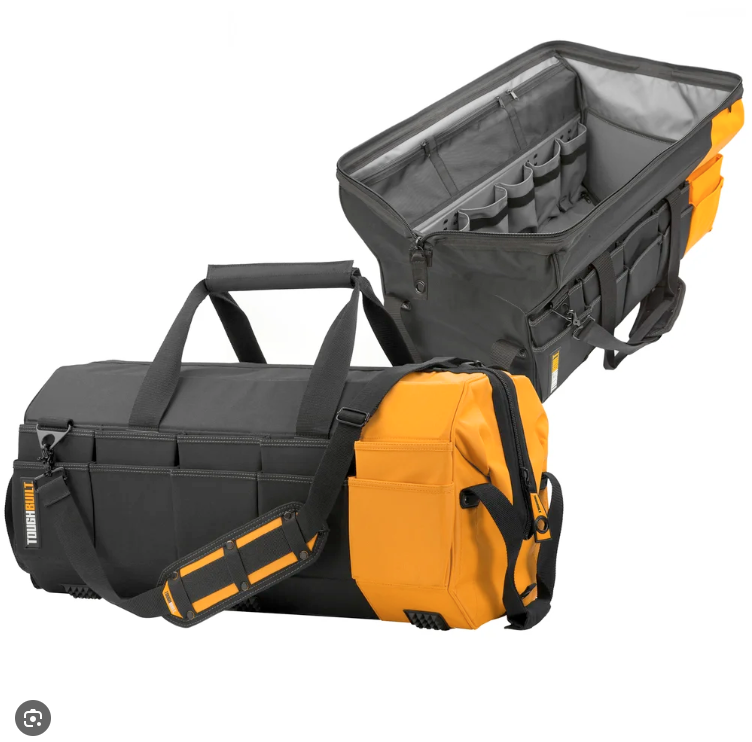
The bottom is usually the highest-wear area of a tool bag.
It experiences:
- Ground contact
- Tool pressure
- Dirt
- Friction
A common approach is therefore:
600D body + 1680D bottom
This provides a strong balance between:
durability + weight + cost
For very heavy-duty products, manufacturers may also add:
- Double fabric layer
- PE board
- EVA reinforcement
- Rubber feet
- Molded plastic base
In these cases, fabric is only one part of the bottom-protection system.
7. Coating and Water Resistance
Neither 600D nor 1680D is automatically waterproof.
Water resistance depends primarily on:
- PU coating
- PVC backing
- Other laminations
A well-coated 600D fabric may provide better moisture resistance than an uncoated 1680D fabric.
For tool bags, water resistance can be useful when the product is used:
- Outdoors
- In workshops
- Around wet surfaces
However, the finished bag also contains:
- Seams
- Zippers
- Openings
so coated fabric does not automatically make the entire product waterproof.
600D vs 1680D for Different Tool Bag Types
General-Purpose Tool Bag
Recommended:
600D
Suitable for:
- Household use
- DIY
- Light professional tools
Why:
- Lower weight
- Lower cost
- Adequate durability
Contractor Tool Bag
Recommended:
600D + 1680D reinforcement
Suitable for:
- Construction
- Installation
- Daily professional use
Why:
Provides strong protection at wear points without making the complete bag excessively heavy.
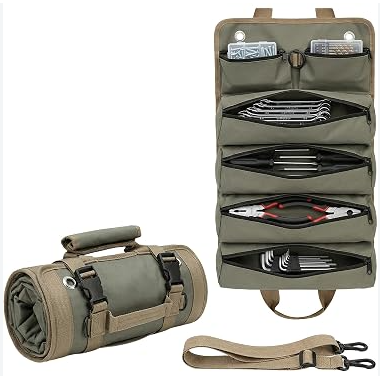
Heavy-Duty Mechanic Bag
Recommended:
1680D
Suitable for:
- Heavy hand tools
- Industrial applications
- Frequent ground contact
Why:
Higher abrasion resistance and stronger structure.
Promotional Tool Kit Bag
Recommended:
600D
Suitable for:
- Hardware promotions
- Corporate gifts
- Small tool sets
Why:
Cost control is usually more important than extreme durability.
8. Pockets and Tool Organization
Tool bags often include many external pockets.
Each pocket creates:
- Additional seams
- More stress points
- More fabric layers
Using 1680D for every pocket can make the bag unnecessarily thick.
A practical design may use:
- 600D main pockets
- Reinforcement at pocket openings
- 1680D on high-wear panels
Material placement should follow actual stress rather than using the heaviest fabric everywhere.
9. Handles Matter More Than Fabric in Heavy Loads
A heavy tool bag puts enormous stress on the handles.
Important design factors include:
- Handle webbing width
- Stitch pattern
- Attachment length
- Reinforcement
Strong tool bags often use webbing that continues around or beneath the bag rather than attaching only to a small section of fabric.
This distributes the load more effectively.
Even 1680D fabric cannot compensate for a poorly designed handle system.
10. Zipper Selection
Tool bags often experience heavy side pressure.
The zipper must tolerate:
- Overpacking
- Dirt
- Frequent opening
Heavy-duty bags may use:
- Large nylon coil zippers
- Larger zipper sliders
- Double zipper pulls
The zipper specification should match the intended product level.
Using premium 1680D fabric with a weak zipper creates an unbalanced product.
Printing and Branding
600D generally provides a relatively smooth surface suitable for:
- Screen printing
- Heat transfer
- Embroidery
1680D often has a more visible coarse weave.
This can affect fine printed detail.
For heavy-duty 1680D bags, buyers may prefer:
- Embroidery
- Woven patches
- Rubber patches
rather than large detailed graphics.
For promotional programs where large logo printing is important, 600D may be easier to work with.
Is 1680D Always Better?
No.
1680D provides more material and better resistance to harsh wear, but this comes with trade-offs.
It can make the bag:
- Heavier
- More expensive
- Less flexible
- Harder to sew
If the tool bag is intended for light or medium use, these disadvantages may provide little practical benefit.
Using the heaviest available fabric is not automatically good product engineering.
Is 600D Too Light for Professional Tool Bags?
Not necessarily.
600D is widely used for bags because it provides a useful balance between performance and cost.
A professional tool bag can use 600D successfully if it includes:
- Reinforced bottom
- Strong webbing
- Quality stitching
- Appropriate load design
For demanding professional applications, however, buyers should consider additional reinforcement or heavier fabric at high-wear areas.
What Should Buyers Compare During Sampling?
Do not compare only fabric swatches.
Test the finished tool bag.
Load Test
Fill the bag with realistic tools.
Check:
- Handles
- Bottom
- Seams
Abrasion Test
Pay particular attention to:
- Bottom panel
- Corners
Repeated Carrying
Carry the loaded bag repeatedly.
Look for fabric or stitch deformation.
Structure
Check whether the bag:
- Stands upright
- Collapses
- Distorts under load
Finished Weight
Compare the empty 600D and 1680D versions.
This helps determine whether the extra durability is worth the extra weight.
Common Buyer Mistakes
1. Assuming Denier Equals Finished Strength
Denier describes yarn size, not complete bag durability.
2. Using 1680D Everywhere
This often adds unnecessary:
- Weight
- Cost
- Production complexity
3. Ignoring the Bottom
For many tool bags, bottom construction matters more than increasing the denier of the side panels.
4. Comparing Different Coatings
A PVC-backed 1680D fabric and PU-coated 600D fabric are not directly equivalent.
Compare:
- Fabric
- GSM
- Weave
- Coating
together.
5. Ignoring Handles and Seams
Heavy fabrics do not prevent handle or seam failure.
Which Material Should Buyers Choose?
Choose 600D polyester when:
- Weight matters
- Cost is important
- The tool bag is for general use
- Printing is important
- Order quantity is large
Choose 1680D polyester when:
- High abrasion is expected
- Heavy tools are carried
- The bag is used daily on jobsites
- Premium durability is required
- Strong structure is important
Choose 600D + 1680D combined construction when:
- The main body does not need maximum durability
- The bottom and corners experience much more wear
For many professional tool bags, this mixed approach provides the best balance.
Practical Specification Examples
General Tool Bag
Main Fabric: 600D polyester
Bottom: Reinforced 600D
Handles: Heavy polyester webbing
Application: Household and light professional tools
Priority:
cost + weight + everyday durability
Professional Contractor Bag
Main Fabric: 600D polyester
Bottom: 1680D polyester
Corners: 1680D reinforcement
Handles: Full-wrap webbing
Application: Daily contractor use
Priority:
balanced weight + high-wear durability
Heavy-Duty Tool Bag
Main Fabric: 1680D polyester
Bottom: Double 1680D or reinforced base
Handles: Heavy full-wrap webbing
Zipper: Heavy-duty zipper
Application: Industrial and professional tools
Priority:
maximum durability + abrasion resistance
Custom Tool Bag Solutions from INITI
INITI develops custom tool and equipment bags for:
- Hardware brands
- Tool companies
- Industrial suppliers
- Contractors
- Promotional programs
Material options can include:
- 600D polyester
- 900D polyester
- 1680D polyester
- RPET polyester
- Other heavy-duty fabrics
Tool bag structures can include:
- Open-mouth tool bags
- Zipper tool bags
- Tool totes
- Equipment carriers
- Multi-pocket work bags
Customization options include:
- Fabric denier
- Coating
- Reinforced bottom
- Internal dividers
- External pockets
- Webbing handles
- Shoulder straps
- Zippers
- Printing
- Embroidery
- Packaging
For material selection, buyers should provide:
- Intended tools
- Expected load
- Bag dimensions
- Usage environment
- Estimated quantity
- Target price
This makes it possible to determine whether the project actually requires 1680D or whether a reinforced 600D construction provides better value.
FAQ
Is 1680D polyester stronger than 600D?
Generally yes. 1680D uses heavier yarn and typically provides greater abrasion and tear resistance, but actual performance also depends on weave, GSM and coating.
Is 600D polyester strong enough for tool bags?
Yes, for many general-purpose and medium-duty tool bags. High-wear areas may need additional reinforcement.
Is 1680D much heavier than 600D?
It is generally significantly heavier because more material is used. The actual difference depends on the specific fabric GSM and coating.
Is 1680D waterproof?
No. Denier does not determine waterproofing. Water resistance depends on coating, seams and complete bag construction.
Which material costs more?
1680D generally costs more because it contains more material and can be more difficult to manufacture.
Which is better for a contractor tool bag?
A combination of 600D for the main body and 1680D for the bottom and high-wear areas often provides a strong balance.
Which is better for promotional tool bags?
600D is usually more suitable because it provides sufficient durability with lower cost and weight.
Should the entire tool bag be made from 1680D?
Not necessarily. Strategic reinforcement often provides better cost and weight efficiency than full 1680D construction.
Conclusion
600D and 1680D polyester serve different tool bag requirements.
600D is generally the better choice when buyers prioritize:
- Lower weight
- Lower cost
- Easier production
- General-purpose durability
1680D is generally the better choice when buyers prioritize:
- Higher abrasion resistance
- Greater tear resistance
- Stronger structure
- Heavy-duty professional use
For many tool bags, however, the best answer is not choosing one material exclusively.
A construction such as:
600D main body + 1680D bottom and high-wear areas
can provide much of the durability benefit without adding unnecessary weight and cost to the entire bag.
The most reliable sourcing decision should therefore consider:
strength + weight + cost + where the bag actually wears
rather than assuming that the highest denier automatically produces the best tool bag.



