If you sell or store pillows, cushions, duvets, or full bedding sets, a pillow bag is that practical outer package that keeps everything clean, presentable, and easy to carry. Think of it as a reusable “home” for soft textiles: dust-proof, shelf-friendly, and brandable. This expanded guide goes deep—materials, sizing math, structure options, QC, sustainability, pack-out tips, and what to send your supplier—so you can spec confidently and avoid trial-and-error.

Quick answer
A pillow bag for bedding is a soft-goods packaging bag designed for protection + display + portability. Most brands use PP nonwoven, PE/PP clear film, or transparent PVC (sometimes with a clear window), plus zipper and carry handles. You size it from the real folded product block, add 2–5 cm ease, then choose features (binding, window, card sleeve) that match your brand and budget.
Material choices
Use this chart when you’re deciding what the bag should be made of. If you’re new to this, start with PP nonwoven for breathable, reusable packaging, PVC for high clarity and structure, or PE/PP clear for simple, economical single-piece packs.

Table 1 — Material comparison for pillow bags
| Material | Look & Feel | Typical Thickness / GSM | Pros | Watch-outs | Best For |
|---|---|---|---|---|---|
| PP Nonwoven | Matte, fabric-like, breathable | 60–120 gsm | Reusable, light, scuff-tolerant, easy branding | Not fully transparent unless you add a window | Everyday retail, e-commerce, hotel/linen turnover |
| PE/PP Clear Film | Clear, soft, flexible | 0.06–0.12 mm (60–120 μm) | Budget-friendly, barcode-friendly, quick ID | Softer handfeel; lower “premium” look | Single pillows, basic cushion packs, online fulfillment |
| PVC (Vinyl) Transparent | High clarity, crisp, structured | 0.18–0.35 mm | Premium display, holds shape, wipes clean | Heavier/stiffer; specify low-odor formulas | Flagship lines, store walls, giftable sets |
| EVA (Optional) | Soft touch, semi-clear | 0.18–0.30 mm | Nicer handfeel than PE, often lower odor than standard PVC | Cost up from PE/PP | Gift packs, kids/crib ranges |
| Cotton/Poly Fabric (Optional) | Textile look, opaque | 6–12 oz (approx.) | Very durable, upscale | Higher cost; add window or card for ID | Boutique sets, limited editions |
Tip: If your product needs to “breathe” (down/feather or cotton-rich fill), nonwoven with a clear window is a sweet spot.
Structure & features
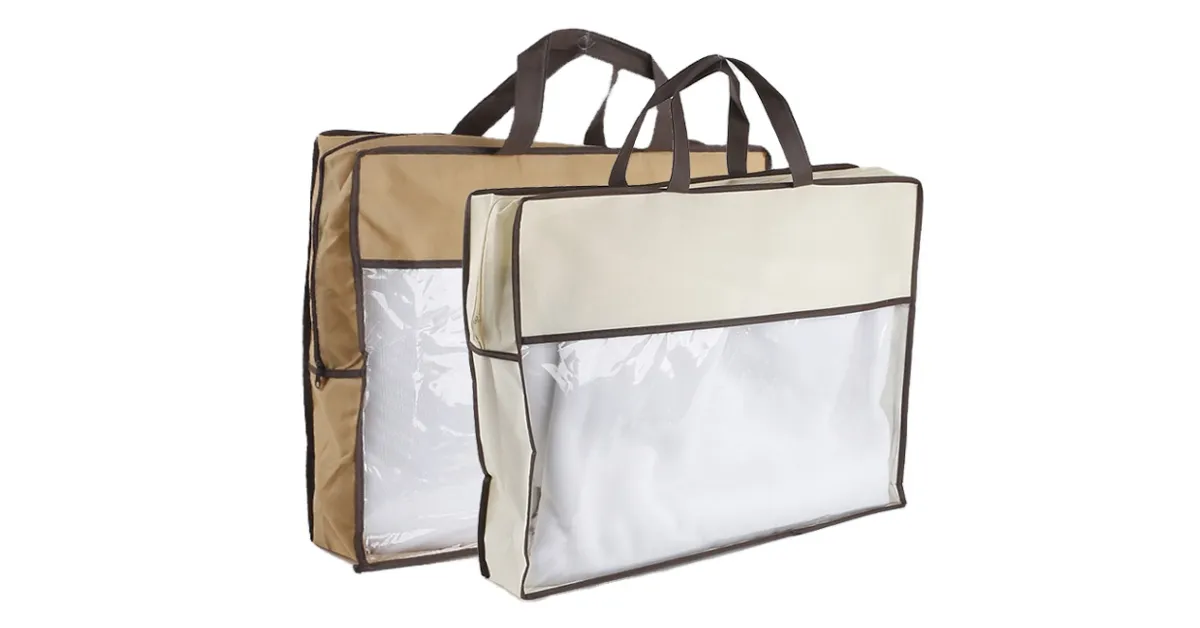
Most pillow bags are simple: a body panel + zipper + carry handle. You can upgrade with binding (for strength and clean edges), windows (for display), and card sleeves (for barcodes and care cards). Choose features based on how customers will carry, store, and display the set.
Table 2 — Feature options and when to use them
| Feature | What it does | When to use |
|---|---|---|
| Zipper (nylon/resin) | Clean open/close; reusable | Standard for retail & storage; size up for heavy duvets |
| Hook-and-loop | Quick access, no slider | Budget lines, kids bedding, fast pack-out |
| Carry handle (webbing/rope/die-cut) | Easy to carry | All retail packs; pick webbing width for load |
| Binding / Piping | Reinforces seams, adds structure | Premium lines; improves shelf presence |
| Clear window (PVC/PP) | Product visibility | Color/print-led SKUs, boutique displays |
| Card sleeve / Hang tab | Insert care card & barcode; hang | Chain retail, planogram compliance |
| Corner gusset / side gusset | Adds volume without bulk | High-loft pillows, thick winter duvets |
| Label pocket | Replaceable ID/size card | Hotel/linen management & reissue cycles |
Sizing: the practical math
Rule of thumb: measure the actual folded product block (after you decide the fold pattern). The bag must fit this block comfortably.
Step-by-step:
- Lay product flat → fold to your chosen plan (see Section 4).
- Measure length (L) × width (W) × height (H, i.e., loft) of the folded block.
- Add ease: typically +2–5 cm on each dimension for easy loading and stress-free zipping.
- If adding thick binding or piping, add +0.5–1 cm per edge as needed.
Quick formula (outer finished size):
Bag L = L(block) + 2–4 cm
Bag W = W(block) + 2–4 cm
Bag H = H(block) + 1–3 cm (if your pattern defines depth; for flat envelopes, add ease to L/W)
Table 3 — Handy size cheatsheet
| Product | Typical Product Size | Suggested Bag (Outer) | Why |
|---|---|---|---|
| Standard pillow | 50 × 70 × 18 cm | 54 × 74 × 20 cm | 2–4 cm ease all around for smooth loading |
| Square cushion | 45 × 45 × 15 cm | 48 × 48 × 17 cm | Keeps corners crisp without crushing |
| Queen duvet (spring) | 200 × 230 × ~20 cm loft | 54 × 46 × 20 cm (folded) | Sized for folded stack; confirm your folding plan |
| Winter duvet (high-loft) | 220 × 240 × ~30 cm loft | 60 × 50 × 24 cm | More volume + stronger handles & zipper |
| 4-piece bedding set | Varies | Custom, based on folded block | Measure the folded “block,” then add ease |
Pro tip: Decide your fold pattern first (how many folds, which face to the window). That determines the final “block” you’re packing—and the bag size.
Pack-out and folding
Your fold plan affects everything: creasing, visible face, final size, and how evenly weight sits on the handle.
Table 4 — Common fold patterns (choose based on loft & fabric)
| Pattern | How it works | Good for | Notes |
|---|---|---|---|
| Tri-fold (long side) | Fold length into thirds | Pillows, low-loft duvets | Simple, fast, consistent output |
| Book fold | Fold in half, then in half | Medium-loft duvets, sets | Clean front face for window display |
| Roll & tuck | Roll, then tuck ends | Foam pillows, quilts | Minimizes hard creases; secure with band |
| Cross fold | Fold L, then W | Mixed sets | Balanced block; good for card alignment |
Tip: Mark the “window face” during packing so the best side always shows forward.
Brand look & printing
- Nonwoven loves screen print or simple heat-transfer logos. Keep colors controlled (1–3 typically) for clean edges.
- Clear bags (PE/PP) usually use insert cards or printed stickers—fast and low cost.
- PVC pairs nicely with contrasting binding + insert card for a boutique look.
- Must-have text: product name, size, fill, care icons, barcode/QR, and a short benefit line (“Breathable cotton cover • Soft support”).
- Photograph the product inside the bag for your PDP—customers buy with their eyes. Avoid glare by shooting at a slight angle and using soft light.
Quality control
You don’t need a lab to do useful checks. Here’s a compact QC table your team can run during incoming inspection or at end of line.
Table 5 — Simple QC checks
| Test / Item | Why it matters | Quick method |
|---|---|---|
| Handle pull test | Prevents handle tear-outs in store | Load product, hold by handle 60 sec; inspect stitch |
| Zipper run & stop | Smooth open/close, no pop-opens | 10 cycles open/close; confirm end-stop secured |
| Seam & binding strength | Avoids split seams over time | Gentle “peel” pull at corners and along edges |
| Clarity / scratch rate | Affects shelf appeal | Inspect under bright light; reject foggy/scuffed pieces |
| Color & print alignment | Consistent brand look | Compare to master; check Pantone & placement |
| Odor check | Out-of-box experience | Air a sealed sample 15 min; quick smell test |
AQL tip: Keep one master approved sample (“golden sample”) at the line. Reject anything that visibly deviates on color, stitching, or clarity.
Compliance & low-odor options
- Ask for low-odor formulations for PVC and inks; specify your target (“low-odor packaging suitable for retail display”).
- Align with your market’s restricted substances expectations and request a materials declaration from your supplier.
- For kids lines, use larger zipper pulls (easy grip) and reinforced binding; double-check small-part risks on accessories.
Sustainability
- Design for reuse: Zippers + sturdy handles mean the bag won’t be single-use.
- Simplify materials: Monomaterial builds (e.g., PP nonwoven body + PP webbing) are easier to sort downstream.
- Right-weighting: Don’t over-spec GSM or thickness—target what passes your handle pull and zipper cycle tests with margin.
- Clear labeling: Add simple material icons (PP, PE, PVC) and care/disposal notes appropriate to your market.
- Window strategy: If you need a large window, keep it cleanly bonded and consider reducing its area to hit weight and cost goals.
Cost control without sacrificing quality
Small decisions move unit cost more than you think. Use the levers below to tune price while protecting function.
Table 6 — Cost levers you can pull
| Lever | Saves cost by… | Watch-outs |
|---|---|---|
| Material step-down | PP nonwoven vs PVC; lower GSM/μm | Don’t under-spec for heavy duvets |
| Binding width | Narrower binding, fewer passes | Keep strength at stress points |
| Print method | Fewer colors; sticker/insert vs direct print | Color consistency on stickers |
| Handle spec | Webbing width & length optimization | Comfort vs cost balance |
| Window size | Reduce window area | Maintain enough product visibility |
| Carton pack | Tighter folds; more units per carton | Avoid over-creasing the product |
Shipping & storage
- Cartonization: Design bag dimensions to nest well in master cartons; aim for even layers and minimal void space.
- Moisture control: For clear film or PVC, avoid packing damp textiles; if needed, add a small desiccant and note it on the BOM.
- Stacking: PVC with binding stacks neatly for retail backrooms; nonwoven compresses better for e-commerce hubs.
- Labeling: Put size and SKU on the spine so staff can read it on shelves without unstacking.
Common problems & quick fixes
- Zipper waves or ripples → Add ease or upgrade zipper tape stiffness; check sewing tension.
- Handle tear-outs → Increase stitch density, add reinforcement patch, or widen webbing.
- Foggy PVC → Ask for higher-clarity grade; protect with film during transit; review storage temperature.
- Wrinkled insert cards → Use heavier card stock or place the sleeve slightly away from curved edges.
- Bag too tight → Re-measure the folded block, add 2–5 cm ease; remember binding adds thickness.
Where pillow bags beat the alternatives
- Versus vacuum compression bags: Vacuum saves space for long storage but isn’t display-friendly and scuffs easily. Pillow bags are better for retail, repeated access, and brand presentation.
- Versus plain PE carrier bags: Carriers are cheap and quick, but pillow bags give you structure, zipper reuse, better graphics, and stronger handles.
What to send your supplier
Use this as your ready-to-go spec sheet. Filling this out saves days of back-and-forth.
Table 7 — Order spec template (BOM header)
| Spec Item | Your Choice / Notes |
|---|---|
| Use case | Retail / E-commerce / Hotel linen / Seasonal storage |
| Bag size (outer) | L × W × H (add 2–5 cm ease) |
| Material | PP nonwoven (GSM) / PE or PP (μm) / PVC or EVA (mm) |
| Color(s) | Body, binding, handle; Pantone if needed |
| Closure | Zipper (type, color) / Hook-and-loop |
| Handle | Webbing/rope/die-cut; width & length |
| Window | Full / Partial; size & position |
| Branding | Screen print colors; insert card size; sticker |
| Packaging | Fold style; individual poly; units per carton |
| QC targets | Handle pull pass; 10× zipper cycles; AQL appearance |
| Compliance | Low-odor requirement; market declarations |
| MOQ / Lead time | Target qty and ship date |
| Samples | White sample / Printed sample, due date |
Sample copy you can reuse on your product page
A reusable pillow bag that keeps bedding clean, easy to carry, and ready to display. Choose breathable nonwoven or premium clear PVC, add a zipper, window, and color-matched binding, then print your brand where it matters. Great for pillows, cushions, duvets, and seasonal storage.
Why work with us (OEM/ODM)
We’re a professional manufacturer of bedding packaging with OEM & ODM support. You can mix and match materials (PP nonwoven / PE/PP clear / PVC / EVA), thickness or GSM, zipper and handle types, binding colors, and window sizes. We help you:
- Confirm right-sized bags from real product measurements
- Choose low-odor and right-weight materials for your market
- Hit retail planograms with consistent colors and print
- Set QC standards (handle pull, zipper cycles, AQL) you can trust
Want quick samples or a costed BOM? Share your folded product size, preferred material, and target budget—we’ll map out two or three options so you can pick the best fit.
Conclusion
A well-designed pillow bag does three jobs at once: it keeps bedding clean and protected, it makes products easy to carry and store, and it gives your brand a sharp, consistent presentation online and in stores. Start with the right material (nonwoven for breathability, PVC for clarity, PE/PP for value), size it from the real folded block with a bit of ease, and add only the features that move the needle—zipper, handle, binding, and a window or card sleeve. Lock in a simple QC routine and clear BOM, and you’ll ship packaging that looks great, works hard, and keeps costs under control.
FAQs
Do pillow bags need to be breathable?
If you’re packing cotton-rich or down/feather fill, yes—give the fabric a little room to “breathe.” A PP nonwoven body (with or without a clear window) helps moisture balance out and keeps that fresh feel longer. For foam or synthetic fills, clear film or PVC is totally fine—just don’t trap damp air when you pack.
Quick tips:
- Make sure products are fully dry before bagging.
- If your warehouse is humid, add a tiny desiccant and note it on the BOM.
- Avoid compressing high-loft down too hard; let it puff back after loading.
Can I get high transparency for in-store display?
Absolutely. If you want that “wow, look at the quilting!” moment, go PVC for crystal clarity and a crisp, premium look. Prefer the warmth of nonwoven? Add a large window—best of both worlds. Pair it with contrasting binding and a clean insert card and your shelf presence jumps instantly.
Pro moves:
- Ask for low-odor PVC grades.
- Use a protective film during shipping to prevent scuffs; peel before display.
- Shoot PDP photos with soft, angled light to avoid glare.
What’s the standard zipper?
A nylon coil zipper is the go-to—smooth, reliable, and easy to color-match. For pillows and cushions, a #3 or #4.5 works; for heavy duvets or multi-piece sets, size up to #5 and reinforce the ends. If customers open/close the bag a lot, consider an auto-lock slider so it stays put.
What we like to spec:
- Nylon coil zipper (color-matched) + bartack at both ends.
- Wider puller on kids or hospitality lines (easier grip).
- Test 10 open/close cycles in QC so the slider beds in.
I sell online only—what’s the best value?
Go PE/PP clear film with a zipper and a neat insert card or printed sticker. It’s light (saves freight), barcode-friendly, and easy for customers to reuse at home. Want it to feel a touch more premium? Add a small windowed label pocket or switch to nonwoven + window for mid-range sets.
E-com pointers:
- Keep film thickness around 60–100 μm for a nice balance of feel and cost.
- Put size/SKU info on the spine so warehouse teams can pick faster.
- Photograph the product inside the bag—customers buy with their eyes.
Not sure on size—what now?
Fold the product the way you’ll actually ship it, then measure the real block: L × W × H (loft). Add 2–5 cm of ease so the zipper isn’t fighting you. High-loft or heavy sets? Add a little more ease and upgrade the handle and binding.
Simple workflow:
- Choose the fold pattern (tri-fold, book fold, roll—whatever suits the fill).
- Measure the folded block.
- Add ease (2–3 cm for pillows, 3–5 cm for chunky duvets).
- If you use thick binding/piping, add +0.5–1 cm on the affected edges.
- Make one golden sample; if it loads smoothly in 5 seconds, you nailed it.
How do I clean the bag after use?
For clear film or PVC, wipe with a damp cloth and a drop of mild soap, then air dry—done. For nonwoven, spot-clean gently and avoid soaking (it’s fabric-like, not a raincoat). If there’s a lingering new-material smell, just air it out overnight.
Do / Don’t:
- Do store bags dry and out of direct sun (UV can haze clear film).
- Don’t use harsh solvents, bleach, or high heat (no irons, no dryers).
- Do reshape the bag while it dries so it stays crisp for next time.