
You want your child to feel comfortable and safe at school, so choosing the right kids backpack size matters more than you might think. Backpacks that are too big or too heavy can lead to back pain.
- By age 14, 30% of girls and 26% of boys report lower back pain.
- Over half of school-aged kids experience some kind of back discomfort.
Check out the recommended backpack sizes and weight limits for each age group:
| Age Group | Backpack Capacity | Max Weight Limit |
|---|---|---|
| Toddlers (1-2 years) | 3-5 litres | 0.5 kg |
| Preschoolers (3-4 years) | 6-9 litres | 1.5 kg |
| Early Primary (5-6 years) | 10-12 litres | 2 kg |
| Late Primary (7-11 years) | 15-20 litres | 5 kg |
| Secondary School (12+ years) | 20-28 litres | 7 kg |

You can use this guide to make sure your child’s backpack fits well, feels comfortable, and meets safety standards.
Key Takeaways
- Picking the right backpack size helps your child stay comfortable and healthy.
- Backpacks should weigh only 10-15% of your child’s body weight. This keeps your child from getting hurt.
- Measure your child’s torso to find a backpack that fits well.
- Choose backpacks with padded and adjustable straps. These straps make carrying easier and more comfortable.
- Get a backpack with many compartments. This helps organize things and spreads out the weight.
- Check the backpack’s fit often, especially after your child grows. This makes sure your child stays comfortable.
- Tell your child to use both shoulder straps. This helps spread the weight evenly.
- Change backpacks if they look worn out or do not fit your child anymore.
Kids Backpack Size Chart
Choosing the right kids backpack size can make a huge difference in your child’s comfort and health at school. Let’s break down the best options for each age and grade group so you can find the perfect fit.
Preschool & Kindergarten
Recommended Height & Width
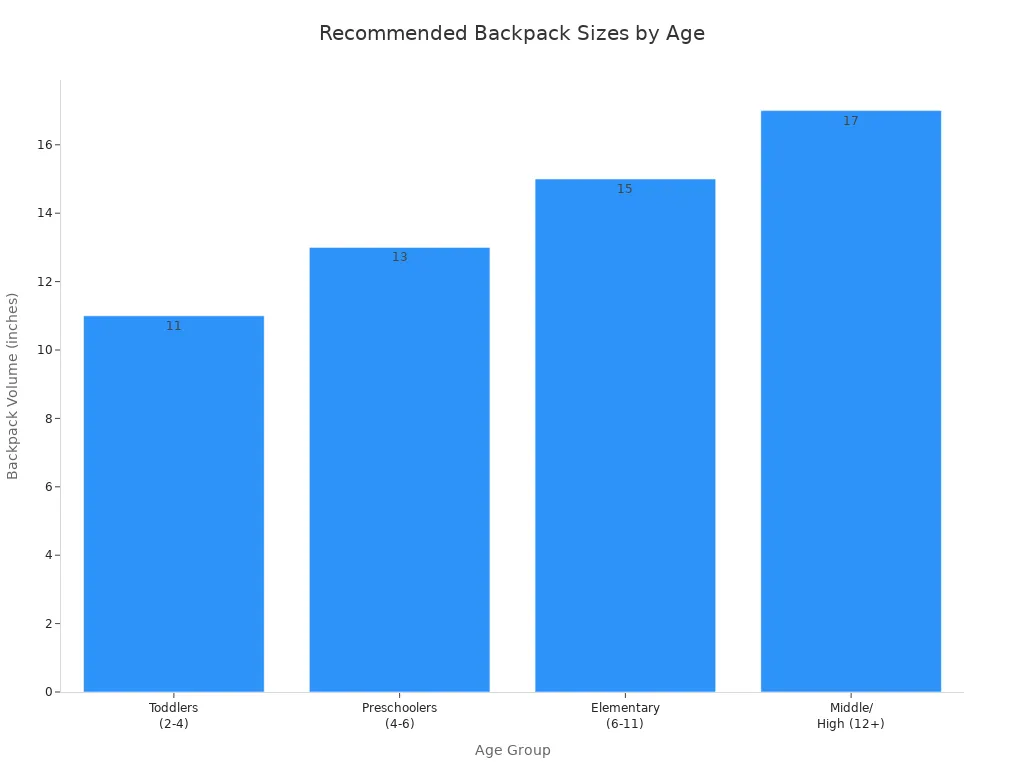
At this age, kids are small and energetic. You want a backpack that sits comfortably on their back without hanging too low or feeling bulky. Look for backpacks that are about 10 to 14 inches tall. The width should not be wider than your child’s torso. Mini backpacks work well for toddlers, while slightly larger ones suit preschoolers.
Here’s a quick table to help you visualize the right dimensions:
| Age Group | Backpack Size | Height Range (inches) | Weight Limit (% of body weight) |
|---|---|---|---|
| Toddlers (2-4) | Mini backpacks | 10-12 | N/A |
| Preschoolers (4-6) | Slightly larger packs | 12-14 | 5-10% |
Tip: Always check that the bottom of the backpack sits above your child’s hips. This helps prevent back strain.
Volume Range
For preschool and kindergarten, you don’t need a large bag. Most kids only carry a lunchbox, a change of clothes, and maybe a small folder. A volume range of 6 to 9 liters is usually enough. This keeps the load light and manageable.
Early Elementary (Grades 1-3)
Recommended Height & Width
Kids in early elementary school start to bring home more books and supplies. You want a backpack that measures about 14 to 16 inches tall. The width should still match your child’s back, not extending past their shoulders. Medium-sized school backpacks are ideal for this age.
| Age Group | Backpack Size | Height Range (inches) | Volume Range (liters) |
|---|---|---|---|
| Elementary (6-8) | Medium backpacks | 14-16 | 10-12 |
Note: Try the backpack on your child before buying. Make sure the straps adjust easily and the bag doesn’t look oversized.
Volume Range
A volume range of 10 to 12 liters gives enough space for a lunchbox, a few books, and a water bottle. This size helps your child stay organized without carrying extra weight.
Upper Elementary (Grades 4-5)
Recommended Height & Width
Older elementary kids need a bit more room for textbooks, notebooks, and sometimes sports gear. Look for backpacks that are 12 to 16 inches tall. The width should still fit your child’s back comfortably.
| Dimension Range | Volume Range |
|---|---|
| 12–16 inches tall | 12 to 20 liters |
Tip: Encourage your child to use both shoulder straps. This helps distribute the weight evenly and keeps their posture healthy.
Volume Range
For grades 4 and 5, a backpack with a volume of 12 to 20 liters works best. This size fits everything your child needs for school without being too heavy or bulky.
A good backpack size chart helps you compare options and pick the right fit for your child’s age and grade. When you choose the right school backpacks, you help your kids stay comfortable, safe, and ready for every school day.
Middle School
Recommended Height & Width
Middle school brings new challenges for kids. They carry more books, folders, and sometimes sports gear. You want a backpack that fits your child’s back without hanging too low or sticking out too far. The right backpack should rest just below the shoulders and end at the waistline. Most middle school backpacks measure between 17 and 19 inches tall. The width should match your child’s back and not extend past the shoulders.
Tip: Have your child try on the backpack with a few books inside. Check that the straps adjust easily and the bag sits snugly against the back.
Volume Range
Middle school kids need more space for their growing list of school supplies. Health and safety organizations recommend a backpack with a capacity between 20 to 30 liters. This size lets your child carry textbooks, binders, a lunchbox, and even a gym outfit without overloading the bag.
- A 25-liter backpack usually holds everything a middle school student needs for the day.
- Look for school backpacks with multiple compartments. These help kids organize their supplies and keep heavy items close to the back.
- Remind your child to use both shoulder straps to spread the weight evenly.
A good fit helps prevent back pain and keeps your child comfortable during long school days. When you choose the right kids backpack size, you support your child’s health and make school life easier.
High School
Recommended Height & Width
High school students often carry laptops, heavy textbooks, and extra gear for after-school activities. You want a backpack that matches your teen’s height and shoulder width. The backpack should not hang below the waistline. Most high school backpacks measure between 18 and 20 inches tall. The width should fit the back and not extend past the shoulders.
Note: Backpacks with chest or waist belts help distribute weight better. An ergonomic design shifts the load from weaker muscles to stronger ones, making it easier to carry heavy items.
Volume Range
High school brings bigger demands, so your teen needs a backpack with enough space but not so much that it becomes unmanageable. Ergonomic research suggests a volume of 30–40 liters for most high school students. Some students may need a bit less or more, depending on their activities.
- A capacity of 25 to 35 liters works well for most students, balancing space and comfort.
- The American Academy of Pediatrics recommends that a backpack’s weight should not exceed 10% to 20% of your child’s body weight.
- Choose school backpacks with padded straps and a breathable back panel for extra comfort.
Encourage your teen to pack only what they need for the day. A well-fitted backpack helps prevent back and shoulder pain, even with a busy school schedule. When you pay attention to kid backpack sizes, you help your child stay healthy and focused on learning.
Age Appropriate Backpack Sizes

Choosing the right backpack for your child is more than just picking a fun color or cool design. Age appropriate backpack sizes help your child stay comfortable, safe, and ready for every school day. When you match the backpack to your child’s age and grade, you support their growing body and make sure they can carry what they need without strain.
Matching Backpack to Child’s Back
Every child is unique. Their height, shoulder width, and back length change as they grow. Proper backpack sizing keeps your child’s posture healthy and prevents aches or injuries. If you pick a backpack that fits your child’s back, you help them feel confident and comfortable at school.
Measuring Back Length
You can measure your child’s back at home. This helps you find a backpack that fits just right. Here’s how you do it:
- Gather a soft measuring tape and ask someone to help you.
- Have your child stand straight against a wall, feet shoulder-width apart, looking forward.
- Ask your child to tilt their head forward. Find the bump at the base of their neck (the C7 vertebra).
- Place your hands on your child’s hips. Find the top of the hip bones on both sides (the iliac crest).
- Measure from the C7 vertebra straight down to the level of the iliac crest. This is your child’s torso length.
- Measure from the outer edge of one shoulder to the other for shoulder width.
- Write down both measurements. You’ll need them when you shop for a new backpack.
Tip: A backpack that matches your child’s torso length will sit comfortably and not hang too low.
Ensuring Proper Width
The width of the backpack matters just as much as the length. The backpack should not be wider than your child’s back or shoulders. If it sticks out too far, it can throw off your child’s balance and make walking awkward. When you check the fit, look for these features:
- Wide, padded shoulder straps that spread the weight evenly.
- A back panel with cushioning and contouring to support the natural curve of the spine.
- A backpack that hugs the back and does not swing or shift when your child moves.
Pediatric studies show that proper backpack sizing with these features helps prevent pressure points, reduces strain on muscles and joints, and supports good posture. Your child will feel better and move more easily at school.
Volume and Capacity by Age
You might wonder how much your child really needs to carry. The answer depends on their age, grade, and school needs. Younger kids need less space, while older students often carry more books and supplies.
What Fits in Each Size
Let’s break down what you can expect to fit in each backpack size:
- Preschool and Kindergarten: These backpacks hold 6 to 9 liters. They fit a lunchbox, a change of clothes, and a small folder. Your child won’t need to carry heavy books yet.
- Early Elementary (Grades 1-3): Backpacks in this range hold 10 to 12 liters. They fit a lunchbox, a few books, a water bottle, and maybe a pencil case.
- Upper Elementary (Grades 4-5): These backpacks hold 12 to 20 liters. They fit textbooks, notebooks, a lunchbox, and sometimes sports gear.
- Middle School: Backpacks here hold 20 to 30 liters. They fit textbooks, binders, a lunchbox, gym clothes, and a laptop or tablet.
- High School: These backpacks hold 25 to 35 liters. They fit heavy textbooks, a laptop, binders, and extra gear for after-school activities.
Remember: The right backpack should fit your child’s back and hold only what they need for school. Too much space can tempt your child to carry extra, making the bag heavier than it should be.
When you focus on proper backpack sizing, you help your child avoid back pain and stay organized. Kids who use the right size backpack feel more comfortable and confident at school. You can make a big difference just by measuring and choosing carefully.
Finding the Perfect Fit
Choosing the right backpack for your child can feel tricky, but finding the perfect fit makes a big difference. When you measure your child and adjust the backpack correctly, you help them stay comfortable and safe at school. Let’s walk through the steps together.
How to Measure
Torso Length
Start by measuring your child’s torso length. This helps you pick a backpack that sits just right on their back. Here’s how you do it:
- Dress your child in light clothing, like what they wear to school.
- Use a soft measuring tape. Ask a friend to help keep the tape straight.
- Have your child stand tall with good posture.
- Find the bump at the base of the neck (C7 vertebra).
- Place your hands on the top of the hip bones (iliac crest).
- Measure from the neck bump straight down to the hip line. This is the torso length.
A backpack that matches your child’s torso length will feel comfortable and won’t hang too low. You want the bottom of the backpack to sit above the hips.
Shoulder Width
Next, measure shoulder width. This helps you choose a backpack that doesn’t stick out or feel awkward. Here’s what you do:
- Have your child stand naturally.
- Measure from the outer edge of one shoulder to the other.
- Make sure your child keeps good posture during the measurement.
A backpack that matches shoulder width will fit snugly and move easily with your child. You want the straps to sit on the shoulders, not slip off or dig in.
Tip: Measure on bare skin for the most accurate fit. This helps you avoid mistakes and makes sure the backpack feels good all day.
Fit Adjustment Tips
Strap Adjustment
Once you have the right size, adjust the straps for a perfect fit. Adjustable straps are key for comfort and safety. Here are some tips:
- Make sure both straps are used. This keeps the backpack balanced.
- Straps should be tight enough to keep the backpack close to the back.
- Wide, padded shoulder straps help spread the weight evenly.
- Straps should not be too tight. Your child should move their arms easily.
Backpack Position
The position of the backpack matters for comfort. Here’s how to check:
- Adjust straps so the backpack sits about two inches above the waist.
- Make sure the backpack rests in the curve of the lower back.
- Use chest and waist straps if the backpack has them. These help spread the weight.
- Check the fit often. Adjust as your child grows or adds more school supplies.
A well-fitted backpack helps kids avoid pain and keeps them ready for school. When you focus on finding the perfect fit, you support your child’s health and make every school day easier.
School Backpacks Features
Comfort Features
Padded Straps
You want your child to feel good carrying their backpack every day. Padded straps make a big difference. They help reduce pressure on your child’s shoulders and keep the backpack from digging in. Adjustable straps also let you change the fit as your child grows. This means the backpack stays comfortable for longer.
Here’s a quick look at why padded, adjustable straps matter:
| Feature | Why It Matters |
|---|---|
| Padded, Adjustable Straps | Reduces pressure points and adapts to your child’s growth |
If your child is in preschool, elementary, or middle school, always check for wide, padded straps. These help spread the weight and keep your child’s shoulders happy.
Breathable Back Panel
A breathable back panel keeps your child cool, even on warm days. This feature lets air flow between your child’s back and the backpack. It helps prevent sweating and makes carrying the backpack much more comfortable.
| Feature | Why It Matters |
|---|---|
| Breathable Back Panel | Prevents overheating and improves comfort |
You’ll find this feature in many school backpacks for older kids, but it’s helpful for younger children too. If your child walks to school or carries their backpack for long periods, a breathable back panel is a must.
Support Features
Chest & Waist Straps
Chest and waist straps give extra support, especially when your child carries heavier loads. These straps help keep the backpack close to the body. They also stop the backpack from swinging side to side. This makes walking and running easier for your child.
- Chest straps add stability for larger backpacks.
- Waist straps shift some weight from the shoulders to the hips.
You’ll see these features more often in backpacks for middle school and high school students. Younger kids may not need them unless they carry a lot.
Ergonomic Design
An ergonomic design means the backpack fits the shape of your child’s back. This helps protect the spine and keeps your child’s posture healthy. Look for backpacks with padded back panels and a shape that follows the curve of the back.
Here’s a table showing some support features and their benefits:
| Feature | Benefit |
|---|---|
| Wide, padded shoulder straps | Comfort and weight distribution |
| Padded back panel | Protection for the spine |
| Chest strap and/or hip belt | Extra stability for larger backpacks |
When you pick a backpack with these support features, you help your child avoid back pain and strain. Always remind your child to use both shoulder straps and adjust the fit as needed.
Safety Features
Reflective Elements
Reflective elements help keep your child safe, especially if they walk or bike to school. These shiny strips or patches make your child more visible to drivers in the early morning or late afternoon. You’ll find reflective details on many school backpacks for kids of all ages.
Tip: Choose a backpack with reflective strips on the front and straps for the best visibility.
Easy Zippers
Easy zippers make it simple for your child to open and close their backpack. Large, sturdy zippers help kids get to their supplies quickly. This is important for younger children who may struggle with small or sticky zippers. Look for zipper pulls that are easy to grab, even with small hands.
When you focus on comfort, support, and safety features, you help your child enjoy carrying their backpack every day. The right features make school life easier and safer for kids at every age.
Practical Features
Compartments
Backpacks get messy when everything is in one pocket. Compartments help keep things neat. If a backpack has different sections, your child finds things faster. Books, lunch, and art supplies stay separate. Nothing gets lost or squished.
Elementary backpacks have a main pocket and a front pocket. This is good for younger kids with fewer items. Older kids need more special compartments. High school students use a padded sleeve for a laptop or tablet. Extra pockets hold chargers, pens, and notebooks.
Here’s a table showing how compartments change as kids grow:
| Age Group | Useful Compartments |
|---|---|
| Elementary (6–12) | Main pocket, front pocket, small organizer |
| High School (13–18) | Laptop sleeve, multiple sections, zippered pockets |
Tip: Ask your child what they carry most. If they bring art supplies, pick a backpack with an organizer. If they use electronics, a padded sleeve keeps devices safe.
Compartments help spread out the weight. Put heavy things close to your child’s back. This makes the backpack easier to carry. Teach your child to use each section for one purpose. This keeps the backpack tidy and helps them find things fast.
Water Bottle Holders
Kids need water during the day. A water bottle holder helps your child stay hydrated. You don’t want bottles rolling inside the backpack and leaking. Most backpacks have a mesh pocket or elastic sleeve on the side. Your child can grab their drink without opening the main pocket.
Elementary backpacks usually have one water bottle holder. This is simple but very helpful. High school backpacks may have two holders or a bigger pocket for large bottles. Some backpacks have insulated sleeves to keep drinks cool.
Here’s a table showing water bottle holders for different ages:
| Age Group | Water Bottle Holder Features |
|---|---|
| Elementary (6–12) | Single mesh pocket, easy access |
| High School (13–18) | Dual holders, insulated sleeve |
Note: Remind your child to use the water bottle holder every day. Drinking water helps them focus and feel good at school.
Water bottle holders keep backpacks cleaner. You avoid spills and sticky messes when bottles stay outside the main pocket. If your child plays sports or walks to school, this feature is even more important.
When you choose a backpack with smart compartments and water bottle holders, you make school easier for your child. These features help kids stay neat, hydrated, and ready for anything. A good backpack saves time and lowers stress for you and your child.
Backpack Weight & Packing Tips
Keeping your child’s backpack light and well-packed is just as important as picking the right size. If you follow a few simple rules, you can help your child avoid aches, pains, and even long-term health problems. Let’s look at how much your child’s school bag should weigh and how you can pack it for the best weight distribution.
Weight Limits by Age
You might wonder, “How heavy is too heavy?” Health experts recommend that a backpack should not exceed 10-15% of your child’s body weight. This helps protect their growing muscles and joints. Here’s a quick table to guide you:
| School Level | Recommended Weight Limit (as % of Body Weight) |
|---|---|
| Preschool | Up to 10% |
| Elementary | Up to 15% |
| Middle School | Up to 15% |
| High School | Up to 15% |
Preschool & Kindergarten
For the youngest kids, keep the school bag capacity small. Their bodies are still developing, so a lighter load is best. Try to stick to the recommended capacity and check the bag often. If the backpack feels heavy, remove any non-essential items.
Elementary
Elementary students can carry a bit more, but you still want to watch the weight. If the bag is too heavy, your child might hunch forward or complain about sore shoulders. Stick to the age-based school bag capacity and remind your child to tell you if the bag feels uncomfortable.
Middle & High School
Older kids often carry more books and gear, but the same rules apply. If the backpack is too heavy, it can cause poor posture, muscle strain, and even joint stress. Encourage your child to use lockers or unload items during the day to keep the load manageable.
If your child carries more than the recommended weight, they might develop back pain, sore muscles, or even redness where the straps rub. Over time, carrying too much can lead to lasting problems with posture and the spine.
Packing Techniques
Packing a backpack the right way makes a big difference. Good weight distribution helps your child stay balanced and comfortable.
Distribute Weight Evenly
- Place the heaviest items, like textbooks, closest to your child’s back.
- Use all the compartments to spread out supplies and avoid putting everything in one spot.
- Make sure the backpack sits snugly against the back to prevent leaning forward.
- Remind your child to adjust the straps so the bag doesn’t swing or shift.
Pack Essentials Only
Packing light is key. Here’s a simple checklist for what your child really needs:
- Water bottle
- Pencil case
- Healthy snack
- Small notebook or diary
- Emergency contact card
Leave out extra toys, gadgets, or anything your child won’t use that day. This keeps the school bag capacity within the recommended range and makes it easier for your child to carry.
Tip: Check your child’s backpack together once a week. Remove anything they don’t need and talk about how to keep the load light.
Smart packing and careful weight distribution help your child stay healthy and happy at school. When you focus on age-based school bag capacity and recommended capacity, you set your child up for success every day.
Choosing Kid Backpack Sizes
When you start choosing the right backpack for your child, you want to make sure it fits well, lasts long, and keeps your child comfortable. Sizing matters at every stage, so let’s break down what you need to know.
Shopping Tips
Fit & Adjustability
You want a backpack that matches your child’s body. Sizing starts with measuring your child’s torso length. Find the bony bump at the base of the neck and measure down to the top of the hips. The backpack height should be between 85% and 115% of this length. Check that the width does not go past your child’s torso. Adjustable straps help you customize the fit and reduce pressure points. Try the backpack on with some weight to see how your child moves and balances.
Here’s a quick checklist for fit and adjustability:
- Measure torso length and shoulder width before shopping.
- Choose a backpack with adjustable, padded straps.
- Make sure the backpack sits above the hips and does not hang too low.
- Look for sternum or waist belts for extra stability.
Durability
Durability is key when choosing the right backpack. Kids use their backpacks every day, so you want materials that last. Pick lightweight fabrics that resist tears. Check for strong seams and sturdy zippers. Padded back panels help cushion the load and keep the backpack in good shape. Wide, padded shoulder straps also add to the durability and comfort.
Tip: If your child walks to school or carries heavy books, look for reinforced bottoms and water-resistant materials.
Mistakes to Avoid
Oversized Backpacks
One common mistake is picking a backpack that is too big. Oversized backpacks can cause poor posture and make walking awkward. Sizing should match your child’s body, not just their school supplies. The backpack should not extend above the shoulders or hang below the waist. For backpacks for primary school children, keep the size small and manageable.
Ignoring Comfort
Ignoring comfort leads to complaints and even injuries. Always check for wide, padded shoulder straps and a cushioned back. Make sure your child wears both straps and adjusts them so the backpack sits in the middle of the back. Limit the weight to no more than 15% of your child’s body weight. Organize supplies so heavier items sit close to the back. Use all compartments to distribute weight evenly.
Note: Teach your child to lift the backpack using their legs and keep it close to their body.
When to Replace
Signs of Wear
You should replace a backpack when you see visible damage. Look for loose seams, frayed fabric, or broken zippers. If the backpack feels too small or too heavy, it’s time for a new one. Bodily complaints like back pain or red marks on shoulders mean the sizing or fit is wrong.
Outgrowing Size
Kids grow fast, and their needs change. If your child can’t fit new school supplies or the backpack no longer appeals to them, consider replacing it. Backpacks for primary school children may need an upgrade as your child moves to higher grades. Sizing should evolve with your child to avoid cramming and poor posture.
Choosing the right backpack means paying attention to sizing, comfort, and durability. When you follow these tips, you help your child stay healthy and happy at school.
Conclusion
Picking the right backpack for preschoolers or older kids helps your child stay comfortable, safe, and ready to learn. When you choose a backpack that fits well, you avoid discomfort and help prevent injuries. Look for these benefits:
- Padded straps and back panels boost comfort.
- Compartments help spread out weight, so your child feels less tired.
- Carrying less than 20% of body weight keeps posture healthy.
Recognizing signs of an ill-fitting backpack can protect your child’s muscles and joints. Use this guide for stress-free shopping. Need something special? We offer custom backpack services, OEM, and ODM for all your backpack needs.
FAQ
What size backpack does my child need for kindergarten?
You want a backpack that is 12–14 inches tall and holds 6–9 liters. This size fits a lunchbox, a change of clothes, and a small folder. Try it on your child to check the fit.
How do I know if a backpack is too heavy?
If your child leans forward, complains about sore shoulders, or struggles to lift the bag, it is too heavy. The backpack should not weigh more than 10–15% of your child’s body weight.
Should my child use both shoulder straps?
Yes! Using both straps helps spread the weight evenly. This keeps your child’s posture healthy and prevents shoulder or back pain. Remind your child to wear both straps every day.
What features should I look for in a school backpack?
Look for these features:
- Padded, adjustable shoulder straps
- Breathable back panel
- Multiple compartments
- Water bottle holder
Tip: Reflective strips add extra safety for kids who walk or bike to school.
How often should I check my child’s backpack for fit?
Check the fit at the start of each school year and after growth spurts. If your child complains about discomfort or the backpack looks too small, measure again and consider a new size.
Can my child use a hand-me-down backpack?
You can use a hand-me-down if it fits well and has no damage. Check the straps, zippers, and padding. Make sure the size matches your child’s back and school needs.
When should I replace my child’s backpack?
Replace the backpack if you see:
- Broken zippers or straps
- Worn-out fabric
- Your child outgrows the size
- Complaints of pain or discomfort
A good backpack supports your child’s comfort and health.