
Introduction
There is no single “best” material for every laptop bag.
A lightweight commuter backpack, minimalist laptop sleeve and executive business bag have very different requirements.
Common laptop bag materials include:
- Nylon
- Polyester
- Felt
- Canvas
- PU
Each material offers a different balance of:
- Durability
- Weight
- Water resistance
- Structure
- Appearance
- Cost
For B2B buyers, material selection should start with the product type.
A material that works well for a padded sleeve may not be suitable for a large laptop backpack.
The more useful question is therefore:
Which material best fits the intended laptop bag structure, user and price point?
Quick Comparison
| Material | Durability | Weight | Water Resistance | Appearance | Cost | Best For |
|---|---|---|---|---|---|---|
| Nylon | Very good | Light | Good with coating | Technical, modern | Medium to high | Commuter and travel laptop bags |
| Polyester | Good to very good | Light to medium | Good with coating | Versatile | Competitive | Backpacks and business bags |
| Felt | Moderate | Light to medium | Limited | Minimal, soft | Low to medium | Laptop sleeves |
| Canvas | Good | Medium to heavy | Limited unless treated | Natural, casual | Medium | Casual laptop totes and sleeves |
| PU | Good surface durability | Medium | Good | Premium, fashion-oriented | Medium | Business bags and fashion laptop cases |
What Should Laptop Bag Material Do?
A laptop bag material usually needs to support several functions.
The outer shell should help with:
- Abrasion resistance
- Daily handling
- Shape retention
- Moisture protection
But the outer material alone does not protect the laptop.
Actual device protection also depends on:
- EVA or EPE padding
- Suspended laptop compartment
- Lining
- Bottom cushioning
- Corner protection
- Zippers
For this reason:
Strong outer fabric does not automatically mean strong laptop protection.
Material selection and padding should be treated as separate decisions.
1. Nylon
Nylon is widely used for:
Its main advantages are:
- Low weight
- Strong abrasion resistance
- Good strength-to-weight ratio
- Flexible hand feel
Common constructions may include:
- 210D nylon
- 420D nylon
- 500D nylon
- Ripstop nylon
Advantages of Nylon
Lightweight
Nylon works particularly well when the product needs to remain light before the laptop is loaded.
This is important for:
- Daily commuting
- Business travel
- Cycling
- Air travel
Good Abrasion Resistance
Laptop bags frequently rub against:
- Desks
- Seats
- Luggage
- Floors
Nylon generally performs well under repeated abrasion.
Flexible Construction
It can be used for:
Water Resistance of Nylon
Nylon itself should not automatically be described as waterproof.
However, it can be combined with:
- PU coating
- TPU lamination
- Water-repellent finishing
to improve water resistance.
For a normal commuter laptop bag, coated nylon can provide useful protection against:
- Light rain
- Splashes
The complete bag still depends on seams and zippers.
Limitations of Nylon
Nylon can cost more than standard polyester.
Some nylon constructions also have a softer appearance, which may not suit buyers wanting:
- Formal business structure
- Natural fabric look
For fashion-oriented or executive laptop bags, PU or canvas may better match the visual requirement.
Best Uses for Nylon
Nylon is a strong choice for:
Choose nylon when the priorities are:
low weight + abrasion resistance + technical performance

2. Polyester
Polyester is one of the most commonly used laptop bag materials.
It provides a strong balance between:
- Durability
- Cost
- Printing
- Structure
- Water resistance
Common specifications include:
- 300D polyester
- 600D polyester
- 900D polyester
Advantages of Polyester
Competitive Cost
Polyester is widely available and suitable for large-volume programs.
This makes it practical for:
- Corporate bags
- Retail backpacks
- Promotional laptop bags
Good Durability
Properly specified polyester performs well for everyday laptop carrying.
600D polyester is especially common because it offers a useful balance of:
- Weight
- Abrasion resistance
- Price
Good Printing
Polyester supports:
- Screen printing
- Heat transfer
- Embroidery
- Other branding methods
This is useful for corporate and promotional projects.
Water Resistance of Polyester
Like nylon, polyester can be combined with:
- PU coating
- PVC backing
- TPU lamination
to improve moisture protection.
PU-coated polyester is common in:
- Laptop backpacks
- Messenger bags
- Business cases
It is generally better described as water-resistant unless the complete construction has been designed for waterproof performance.
Nylon vs Polyester for Laptop Bags
Nylon generally offers:
- Better strength-to-weight
- Softer hand feel
- Strong abrasion performance
Polyester generally offers:
- Lower cost
- Better dimensional stability
- Wide availability
- Strong printing flexibility
For mainstream laptop backpacks, polyester is often the more economical choice.
For lightweight technical bags, nylon may provide better performance.
Best Uses for Polyester
Polyester is suitable for:
- Laptop backpacks
- Business laptop bags
- Promotional computer bags
- Corporate gifts
- Travel laptop bags
Choose polyester when the priorities are:
balanced performance + cost + customization

3. Felt
Felt is very different from nylon and polyester.
It is commonly used for:
- Laptop sleeves
- Tablet sleeves
- Document cases
- Minimalist computer organizers
Felt provides a soft, structured appearance.
It is usually better suited to sleeves than full-size laptop backpacks.
Advantages of Felt
Soft Surface
Felt can provide a gentle surface around the laptop.
This makes it suitable for simple protective sleeves.
Minimal Appearance
Felt has a clean, understated look.
It works particularly well for:
- Corporate gifts
- Design brands
- Office accessories
Natural-Looking Texture
Even synthetic felt can provide a warmer visual style than technical polyester or nylon.
Limitations of Felt
Felt has weaker moisture resistance.
It may absorb:
- Water
- Dirt
- Cosmetic stains
depending on the construction.
It can also show wear or pilling over time.
For a laptop sleeve used mainly:
- Inside another backpack
- In an office environment
this may be acceptable.
For outdoor commuting, felt is usually less practical.
Felt Thickness Matters
A very thin felt sleeve may provide little impact protection.
Buyers should distinguish between:
- Felt shell
- Actual cushioning layer
For better protection, felt can be combined with:
- EVA
- EPE
- Foam
A thick felt appearance does not automatically mean adequate laptop cushioning.
Best Uses for Felt
Felt is best for:
- Laptop sleeves
- Document sleeves
- Corporate gift sets
- Minimalist office products
Choose felt when the priorities are:
simple appearance + soft structure + controlled cost

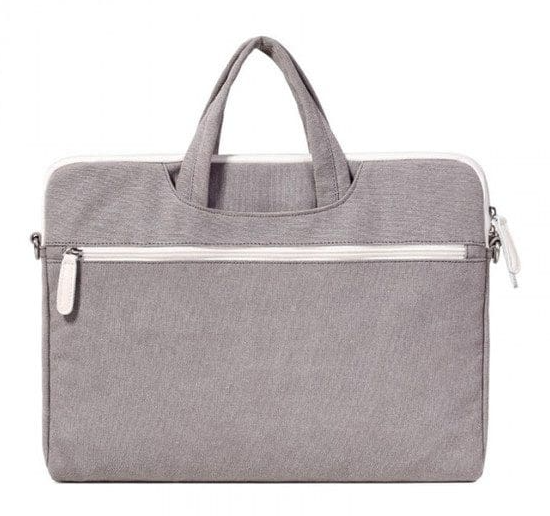
4. Canvas
Canvas is commonly selected for laptop bags when buyers want a more natural or casual appearance.
Common materials include:
- Cotton canvas
- Cotton-polyester canvas
- Recycled canvas blends
It can be used for:
- Laptop totes
- Messenger bags
- Sleeves
- Casual backpacks
Advantages of Canvas
Natural Appearance
Canvas gives laptop bags a more:
- Casual
- Lifestyle
- Heritage-style
appearance.
This is useful for brands that do not want a technical backpack look.
Good Structure
Heavier canvas can provide:
- Shape
- Durability
- Premium tactile feel
Branding Options
Canvas works well with:
- Screen printing
- Embroidery
- Woven labels
Limitations of Canvas
Canvas is usually heavier than lightweight nylon or polyester.
It also has limited moisture resistance unless treated.
Untreated cotton canvas may absorb water.
This makes it less suitable for:
- Heavy rain commuting
- Cycling
- Outdoor technical use
It may also become heavier when wet.
Heavyweight Canvas Is Not Always Better
A thicker canvas can feel more premium, but it also increases:
- Bag weight
- Bulk
- Shipping cost
For a laptop sleeve, excessive fabric weight may provide little additional value if the actual protection comes from foam padding.
The fabric weight should match the product structure.
Best Uses for Canvas
Canvas works well for:
- Laptop tote bags
- Casual messenger bags
- Lifestyle laptop sleeves
- Retail merchandise
Choose canvas when the priorities are:
natural look + structure + brand presentation
5. PU
PU is commonly used to create a leather-like appearance without using natural leather.
It is often used for:
- Business laptop bags
- Laptop sleeves
- Briefcases
- Fashion laptop totes
PU can create a cleaner, more formal appearance than textile materials.
Advantages of PU
Premium Appearance
PU can imitate:
- Smooth leather
- Pebbled leather
- Matte leather
- Textured finishes
This makes it attractive for:
- Corporate programs
- Business accessories
- Fashion retail
Easy Surface Cleaning
Compared with untreated canvas or felt, PU can usually be wiped more easily.
Good Moisture Resistance
The surface can resist light moisture well.
Again, seams and zippers determine overall bag performance.
Limitations of PU
PU quality varies greatly.
Low-quality PU may experience:
- Peeling
- Cracking
- Surface wear
especially after repeated flexing or long-term use.
Buyers should therefore evaluate:
- PU thickness
- Backing fabric
- Flexibility
- Abrasion resistance
rather than selecting PU by appearance alone.
PU vs Genuine Leather
PU is generally:
- More economical
- Lighter
- Easier to standardize in color
It is suitable when buyers want leather-like styling without the cost or sourcing requirements of genuine leather.
However, premium natural leather and PU are fundamentally different materials and should not be marketed as equivalent.
Best Uses for PU
PU works well for:
- Business laptop cases
- Laptop briefcases
- Fashion laptop sleeves
- Corporate gifts
Choose PU when the priorities are:
formal appearance + easy cleaning + controlled cost

Which Material Is Lightest?
For comparable bag structures:
Nylon is usually one of the strongest options for very lightweight construction.
Polyester can also be lightweight.
Felt, canvas and PU generally create heavier or more structured products.
However, finished bag weight also depends on:
- Padding
- Hardware
- Zippers
- Shoulder straps
Material alone does not determine the total weight.
Which Material Is Most Durable?
There is no universal winner.
For abrasion-heavy technical use:
Nylon is especially strong.
For mainstream everyday use:
Polyester provides reliable durability.
For casual applications:
Canvas can last well but requires different maintenance.
For fashion or business products:
PU durability depends strongly on material quality.
Felt is usually better for protected sleeve applications than hard daily outdoor use.
Which Material Is Best for Water Resistance?
Among standard textile constructions:
- Coated nylon
- Coated polyester
are usually practical choices.
For stronger water barriers, buyers can consider:
- TPU laminated nylon
- TPU laminated polyester
PU outer surfaces can also resist light moisture well.
Felt and untreated canvas generally provide lower moisture resistance.
Water-Resistant Is Not Waterproof
A laptop bag using water-resistant material may still allow water through:
- Zippers
- Seams
- Openings
This is particularly important because the product contains electronics.
Buyers should avoid making strong waterproof claims unless the full bag construction supports them.
Which Material Is Best for Laptop Sleeves?
For laptop sleeves, good options include:
Felt
Best for:
- Minimalist appearance
- Corporate gifts
- Office use
PU
Best for:
- Premium business appearance
- Fashion collections
Nylon or Polyester
Best for:
- Technical sleeves
- Travel
- Stronger moisture resistance
The sleeve should also include appropriate padding.
Which Material Is Best for Laptop Backpacks?
For backpacks, nylon and polyester are generally more practical.
They support:
- Multiple compartments
- Shoulder straps
- Zippers
- Reinforcement
- Large production volumes
Polyester is usually more economical.
Nylon may provide stronger lightweight performance.
Which Material Is Best for Business Laptop Bags?
For business-oriented products, common options include:
- PU
- High-density polyester
- Nylon
- Canvas for casual business styles
The choice depends mainly on visual positioning.
A formal executive bag may use PU.
A corporate commuter bag may use 600D polyester.
Which Material Is Best for Corporate Gifts?
Corporate programs often balance:
- Branding
- Cost
- Appearance
Suitable options include:
Polyester
Good for larger quantities and logo customization.
Felt
Good for simple laptop sleeves.
PU
Good for higher-end gifts.
The correct choice depends on target budget.
Material and Padding Should Be Specified Separately
A complete laptop bag specification may look like:
Outer: 600D polyester with PU coating
Lining: 210D polyester
Laptop Padding: 5 mm EVA
Bottom: Reinforced
Closure: No. 8 nylon coil zipper
This is much more useful than simply writing:
Polyester laptop bag.
The same principle applies to every outer material.
EVA vs EPE Padding
Two common laptop protection materials are:
- EVA
- EPE
EVA generally provides:
- Better structure
- Better rebound
- More controlled cushioning
EPE is usually:
- Lighter
- More economical
The outer fabric does not replace either type of padding.
Laptop Fit Matters
A bag can use excellent materials but still provide poor protection if the laptop compartment is too large.
Excess space allows the device to move.
Buyers should confirm:
- Laptop screen size
- Actual device dimensions
- Compartment dimensions
For branded programs, it may be useful to design around specific device ranges.
Suspended Laptop Compartments
For backpacks, a suspended laptop compartment can keep the device above the bottom of the bag.
This helps protect against:
- Bottom impacts
- Moisture on the ground
This structural feature may provide more practical value than simply upgrading from one outer material to another.
Material Appearance and Brand Positioning
Different materials communicate different product styles.
Nylon
Technical and lightweight.
Polyester
Functional and versatile.
Felt
Minimal and soft.
Canvas
Natural and casual.
PU
Formal and fashion-oriented.
Material selection should therefore consider not only technical performance but also how the brand wants the product to look.
Cost Comparison
Exact costs depend on:
- Fabric weight
- Coating
- Finish
- Quantity
- Supplier
But in general:
Polyester often provides one of the strongest cost-performance balances.
Felt can be economical for simple sleeves.
Nylon may cost more when higher-performance grades are used.
Canvas cost depends strongly on fabric weight.
PU ranges widely depending on backing and surface quality.
For accurate sourcing, buyers should compare actual specifications rather than material names.
Practical Material Recommendations
Lightweight Commuter Backpack
Material: Nylon
Priority: Low weight + abrasion resistance
Mainstream Laptop Backpack
Material: 600D polyester
Priority: Cost + durability + customization
Minimalist Laptop Sleeve
Material: Felt
Priority: Simple design + office use
Lifestyle Laptop Tote
Material: Cotton canvas
Priority: Natural appearance + brand image
Business Laptop Briefcase
Material: PU
Priority: Formal appearance + easy cleaning
Common Buyer Mistakes
1. Choosing Material Without Defining the Bag Type
Laptop sleeves and backpacks have different structural requirements.
2. Assuming Thick Fabric Protects the Laptop
Laptop protection depends heavily on foam and compartment construction.
3. Calling Coated Fabric Waterproof
Coating does not seal zippers and seams.
4. Choosing Canvas Only for Appearance
Its extra weight and lower moisture resistance should also be considered.
5. Choosing Low-Cost PU Without Flex Testing
Poor-quality PU may crack or peel over time.
6. Ignoring Finished Bag Weight
Hardware, padding and fabric together determine carrying weight.
What Should Buyers Test During Sampling?
Abrasion
Check high-contact areas such as:
- Bottom
- Corners
- Back panel
Water Resistance
Apply controlled moisture to the outer fabric.
Flexibility
Repeatedly bend:
- PU
- Coated fabrics
- Sleeve edges
Padding
Press and compress the laptop compartment.
Fit
Test the actual laptop sizes.
Zippers
Open and close repeatedly.
The final sample provides much more useful information than a fabric swatch alone.
Which Laptop Bag Material Should Buyers Choose?
Choose nylon when:
- Lightweight performance matters
- Strong abrasion resistance is required
- The product is for commuting or travel
Choose polyester when:
- Cost-performance balance matters
- Large quantities are required
- Custom printing is important
- The product is a mainstream backpack
Choose felt when:
- The product is primarily a laptop sleeve
- Minimal design is preferred
- Outdoor water resistance is not essential
Choose canvas when:
- Natural appearance matters
- The product is lifestyle-oriented
- Some additional weight is acceptable
Choose PU when:
- Formal or premium appearance matters
- Easy surface cleaning is preferred
- The bag is for business or fashion use
Custom Laptop Bags from INITI
INITI develops custom laptop bags for:
- Corporate programs
- Retail brands
- Technology companies
- Travel brands
- Promotional projects
Product types can include:
- Laptop sleeves
- Laptop backpacks
- Laptop totes
- Business laptop bags
- Travel laptop cases
Material options include:
- Nylon
- Polyester
- RPET
- Felt
- Canvas
- PU
Customization can include:
- Laptop compartment size
- EVA or EPE padding
- Suspended compartments
- Water-resistant coatings
- Zippers
- Shoulder straps
- Handles
- Printing
- Embroidery
- Packaging
For development, buyers can provide:
- Laptop size
- Product type
- Target market
- Preferred appearance
- Expected usage
- Estimated quantity
- Target price
If the material has not been finalized, several options can be compared using the same bag structure.
FAQ
What is the best material for a laptop bag?
There is no single best material. Nylon and polyester are strong choices for backpacks, felt works well for sleeves, canvas suits lifestyle products and PU is commonly used for business-style bags.
Is nylon better than polyester for laptop bags?
Nylon generally offers stronger lightweight and abrasion performance, while polyester usually provides better cost efficiency and wide customization options.
Is felt good for laptop sleeves?
Yes. Felt is suitable for minimalist sleeves, especially for office use, but it provides limited water resistance.
Is canvas good for laptop bags?
Yes, especially for casual totes and messenger bags. However, canvas is usually heavier and less water-resistant than coated nylon or polyester.
Is PU durable enough for laptop bags?
Good-quality PU can perform well, but low-quality PU may crack or peel. Material quality should be tested before production.
Which laptop bag material is most water-resistant?
Coated nylon, coated polyester and laminated technical fabrics generally provide stronger moisture resistance than felt or untreated canvas.
Does thicker fabric mean better laptop protection?
Not necessarily. Foam thickness, compartment fit and bottom protection are more important for impact protection.
Which material is best for corporate laptop bags?
Polyester is often the most practical for larger programs, while felt and PU can be suitable for more design-focused or premium gifts.
Conclusion
The best laptop bag material depends on the product structure and user.
Nylon is strong for:
- Lightweight commuting
- Travel
- Technical bags
Polyester is strong for:
- Mainstream laptop backpacks
- Corporate programs
- Cost-controlled production
Felt is strong for:
- Minimalist laptop sleeves
- Office use
Canvas is strong for:
- Lifestyle laptop totes
- Casual designs
PU is strong for:
- Business cases
- Premium fashion styling
Material selection should therefore consider:
durability + weight + water resistance + appearance + cost
But outer fabric should never be evaluated alone.
For laptop protection, buyers also need to specify:
padding + compartment fit + bottom construction + zipper + lining
A well-designed polyester bag with proper EVA padding can protect a laptop better than a premium-looking material with poor internal construction.
For B2B development, the best approach is to define the intended application first and then select the material that provides the right balance of performance, appearance and price.


